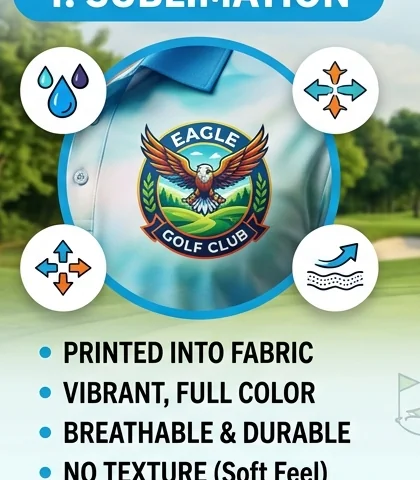
Quick technical definition: Full-coverage sublimation at 200 °C for 40 to 50 seconds is a troubleshooting reference for custom golf apparel. Most of these failures trace back to three controllable variables, not bad luck.
Collar durability: stays flat 50+ industrial washes. 3D silicone logo durability: 60+ washes. Shrinkage: under 1.5% after 5 washes.
Relevant when sourcing for golf brands, country clubs, distributors and corporate buyers in the US and EU; less relevant for pure off-the-shelf retail stock. Request a sample kit before committing to a run.
Updated: 2026-09-02 · Technical review for Quality
Contents
1. What is happening
Sublimation logo fading shows up as a measurable drop in print density after repeated washing or UV exposure. The colour shifts toward grey, edges lose sharpness, and the design becomes visibly lighter against the garment body. On a performance golf polo this usually appears first on high-friction areas such as the chest crest, sleeve badge or lower back panel.
It is most common on polos where the sublimation dye sits on top of a low-polyester blend, where the transfer temperature was below 190 °C, or where the garment is washed above 40 °C without a colour-protect protocol. It is rare on 88% recycled polyester / 12% spandex fabric with a transfer at 200 °C and a tested wash protocol. Fading is a process and material decision, not a random laundry accident.
2. Root causes
Four controllable variables explain the majority of sublimation fading claims on custom golf polos.
- Polyester content below 65%. Sublimation dye bonds to polyester fibres; on cotton-rich blends the dye washes out because there is nowhere for it to lock in. Use 88% recycled polyester / 12% spandex or a minimum 65% polyester base for stable colour.
- Transfer temperature below 190 °C or time under 40 seconds. Insufficient heat leaves dye molecules on the fibre surface instead of inside it. Target 200 °C for 40 to 50 seconds at medium pressure for full penetration.
- Dyestuff not rated for 60+ washes. Some economy sublimation inks score grade 3 or lower on AATCC 61 colourfastness after 20 washes. Specify dyestuff with AATCC 61 grade 4 or higher after 5 washes at 40 °C.
- Care instruction mismatch. Washing at 60 °C, tumble drying above 80 °C, or using bleach strips surface dye faster than mechanical wear. The care label must match the transfer protocol the fabric was tested against.
3. Diagnosis steps
A repeatable check on a counter sample takes about 45 minutes and predicts whether fading will appear within 20 washes.
- Check fibre composition. Burn or lab-test a yarn sample. Below 65% polyester, fading is expected regardless of transfer quality.
- Inspect transfer settings. Ask for the heat press log. Temperature should read 200 °C, dwell time 40 to 50 seconds, pressure medium and even across the platen.
- Run AATCC 61 colourfastness to washing. Five cycles at 40 °C with ECE phosphate-free detergent. Grade 4 or higher is acceptable; grade 3 or lower predicts visible fading inside 10 washes.
- Expose a swatch to UV. 20 hours under a Xenon arc or 40 hours of direct sunlight on a south-facing board. Delta E above 3.0 against an unwashed control indicates poor lightfastness.
- Review the care label. If the label permits 60 °C washing or chlorine bleach, the printed care protocol is faster than the dye can survive.
4. Fix or prevent
Three production-side changes eliminate sublimation fading from the claim list without changing the visual design.
- Switch to a tested 88% recycled polyester / 12% spandex base. The higher polyester content gives the dye a permanent bond; the fabric also carries the verified 165-180 GSM, UPF 50+ and under 1.5% shrinkage after 5 washes spec used across the performance range.
- Lock the transfer recipe at 200 °C / 40-50 s / medium pressure. Print a control swatch every morning and measure colour density with a spectrophotometer. Delta E must stay within 1.5 of the approved standard.
- Use AATCC 61 grade 4+ inks and add a care label cap at 40 °C wash, no bleach, line dry or tumble below 80 °C. This brings the care protocol in line with the dye limits and extends print life past 60 washes.
5. Specifications that prevent it
| Parameter | Value | Condition / test |
|---|---|---|
| Collar durability | stays flat 50+ industrial washes | Stay-Flat interlining, reinforced woven interlining + high-density knit |
| 3D silicone logo durability | 60+ washes | tactile raised logo, soft hand feel |
| Shrinkage | under 1.5% after 5 washes | pre-shrunk fabric treatment, US Standard Fit block |
6. RFQ checklist
Use these questions as your RFQ checklist. A factory that answers all of them in numbers is rare and worth testing:
- What is the MOQ per colorway, and what changes at 50 vs 300 vs 1000 pcs?
- Which certifications are current and verifiable (OEKO-TEX, GRS, BSCI, WRAP, Sedex, REACH)?
- What are the lead times DDP to EU and to US West Coast, contractually?
- What are the shrinkage and colorfastness limits, with test methods?
- What happens to collar shape after 50 industrial washes?
- Ask for a physical sample before PO. Never skip it.
FAQ
Q1. What is the collar durability for Full-coverage sublimation?
stays flat 50+ industrial washes. Stay-Flat interlining, reinforced woven interlining + high-density knit. Confirm the same figure in writing on the tech pack before production.
Q2. Is a sample mandatory before ordering Full-coverage sublimation?
Yes. Fabric hand feel and decoration placement cannot be judged from photos. Order a physical counter sample first; most factories ship one in 3-5 days.
Q3. Does a lower MOQ mean a much higher unit price?
Not always. A factory built for small runs can hold price within a narrow band because its setup cost is low. Ask for the price at 50, 300 and 1000 pcs in one quote.
Q4. How long does production take from PO to delivery?
28-35 days to EU ports under DDP Incoterms, sea to Hamburg / Rotterdam / Felixstowe, from PO confirmation. Express options to the US West Coast are shorter; confirm both at quote time.
Q5. What should I check before signing with a golf apparel factory?
Certification numbers you can verify online, a physical sample, one reference client, and the on-time delivery clause. A factory that hesitates on any of these four is a risk.
Q6. Will collar curling come back after a few washes?
With a stay-flat interlining construction it holds through stays flat 50+ industrial washes. Curling returns when the interlining is thin or the knit density low. That is a spec issue, not a laundry issue.
Related reading
- custom sublimation allover print golf polo
- custom golf polos with logo
- sublimation vs embroidery vs heat transfer
- contact
Sources
- OEKO-TEX Standard 100
- GRS (Global Recycled Standard)
- BSCI
- WRAP
- Sedex SMETA
- REACH (EU)