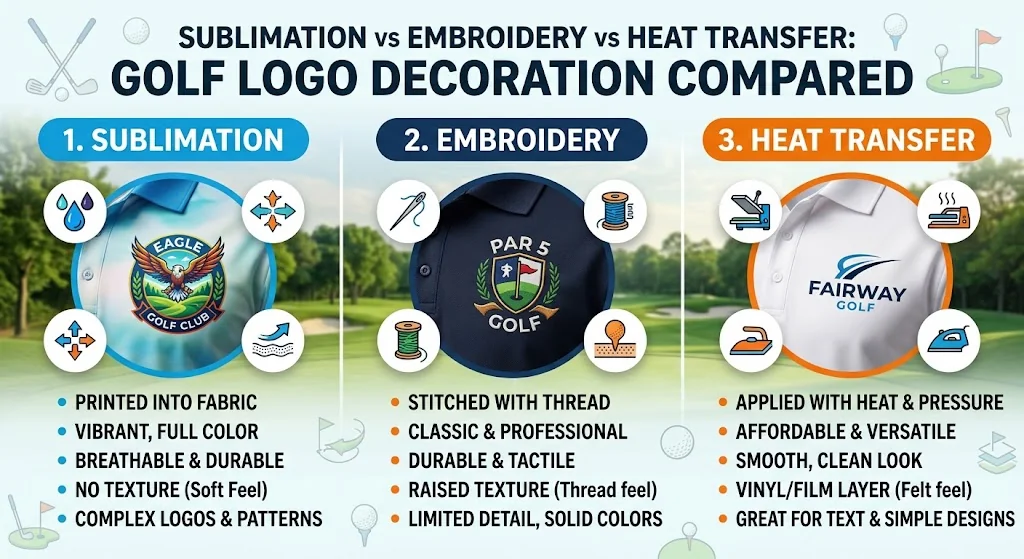
Quick technical definition: Full-coverage sublimation dyes the design into the fabric fibres and adds zero weight; high-density embroidery builds a raised stitched logo on the surface; 3D silicone / heat transfer sits on top as a tactile film. Choose by logo complexity, wash expectations and order volume, not by which looks more expensive.
All three are available at a 50-100 pcs per colorway MOQ with a 24-hour digital mockup and a 3-5 day physical sample, from our Guangzhou facility. 3D silicone is rated for 60+ industrial washes; embroidery and sublimation durability depends on thread density and dyestuff, which we test per batch.
Use sublimation for all-over resort and team prints, embroidery for chest crests on performance polos, heat transfer for small runs and quick turns. Not for a logo that must sit on a seam or a stretch panel without a print-area review. Order a physical sample before the run.
Updated: 2026-09-02 · Technical review for Decoration
Contents
1. The short answer
Sublimation if the design is photographic, covers a large area, or wraps around the garment. Embroidery if the logo is a crest, monogram or club badge under 10 cm. Heat transfer if the order is under 300 pieces, the turnaround is tight, or the logo has gradients that embroidery cannot reproduce.
Embroidery is the only one of the three that adds physical thickness. On a golf polo that means it sits where the club logo should be seen, and it feels like a badge. Sublimation disappears into the fabric. Heat transfer is a compromise: full colour like sublimation, applied like a film, cheaper tooling than embroidery.
2. Side-by-side: Full-coverage sublimation vs High-density embroidery vs 3D silicone
| Dimension | Full-coverage sublimation | High-density embroidery | 3D silicone / heat transfer |
|---|---|---|---|
| Print area | Whole garment, edge to edge | Chest, sleeve, back (under ~10 cm) | Small areas, logo patches |
| Colour range | Photographic, unlimited gradients | Limited by thread colour chart | Full colour, film-based |
| Texture | None, dye in fibre | Raised 3D stitch | Tactile raised film |
| Wash durability | Depends on dyestuff; test per batch | 50+ washes at high density | 60+ industrial washes |
| Weight added | Zero | Noticeable on collar area | Minimal |
| MOQ | 50-100 pcs per colorway | 50-100 pcs per colorway | 50-100 pcs per colorway |
| Digital mockup | 24 hours | 24 hours | 24 hours |
The MOQ, mockup and sample figures above are the factory standard and hold for all three processes. Cost and exact durability differ by order volume and artwork, so they belong in the quote, not in a blog table.
3. Full-coverage sublimation in detail
Sublimation dyes disperse into the polyester fibre at high temperature. The print does not sit on the surface, which is why it does not crack, peel or add weight. Photographic detail and all-over placement are the two things embroidery cannot do. This is where we use it: resort shirts, team packages, women's sets.
It has a constraint. Sublimation needs a high polyester content to hold the dye, so it does not suit heavy cotton blends. The 88% recycled polyester / 12% spandex polo block works well; a cotton-poly hoodie does not. If your artwork is a small chest logo and the garment is cotton-rich, sublimation is the wrong tool.
The cost structure favours larger print areas. Per-piece print cost falls as coverage grows, which is the opposite of embroidery. Ask for a coverage-based quote, not a per-logo quote.
4. High-density embroidery in detail
Embroidery stitches the logo with 30,000 to 50,000 stitches per square meter at high density. The raised feel reads as premium in a clubhouse. Club crests, monograms and event badges are the classic use, and the logo keeps its shape across 50+ industrial washes when the backing and density are right.
Two things people miss. First, thread has a colour chart: a 12-colour photo logo is not a thread logo. Second, embroidery on a stretch panel needs a stabiliser or it distorts the first time the polo is pulled on. We use a fusible backing on performance fabric; a factory that skips this step is the reason embroidered logos pucker.
Minimum practical logo size matters. Below roughly 5 cm, fine detail stitches into a blur. Keep the design bold.
5. 3D silicone / heat transfer in detail
3D silicone is a raised film applied with heat, giving a soft tactile logo with sharp edges. It is the current choice for polo chests, quarter-zip forearms and cap fronts, and it is rated for 60+ washes without cracking.
The trade-off is print area. A 3D silicone logo larger than a palm is unusual and heavy. Gradients are possible but each colour layer is a separate application, which moves the cost.
Heat transfer covers a broader family: silicone, PU and vinyl films. For a first order under 300 pieces, heat transfer avoids embroidery tooling cost and sublimation colour limitations at once. It is the fastest of the three to sample.
6. Cost and longevity
Price per piece, all else equal: embroidery is the most expensive at low volume because of digitising and stitching time. Sublimation is cheapest when the print covers most of the garment. Heat transfer sits in the middle, with the lowest setup.
Longevity ranking, based on our current test data: 3D silicone at 60+ washes leads; high-density embroidery at 50+ is close; sublimation varies by dyestuff, and we test it per batch rather than quote a blanket number. If the garment is a daily-wear staff uniform, treat the wash count as the spec, not the colour.
Exact figures belong in a written quote. A factory that refuses to put wash counts on paper is a reason to walk.
7. How to select
Work down this list.
- Logo area bigger than a hand, or photographic? Sublimation.
- Logo is a crest or monogram under 10 cm, on a polo chest? Embroidery.
- Order under 300 pieces, tight turn, or a gradient logo? Heat transfer.
- Logo crosses a seam or stretch panel? Review the print area with the factory first, whatever the method.
The sample is the decision, not the mockup. The 3-5 day physical sample exists for exactly this reason.
8. RFQ checklist
Use these questions as your RFQ checklist. A factory that answers all of them in numbers is rare and worth testing.
- What is the MOQ per colorway, and what changes at 50 vs 300 vs 1000 pcs?
- Which decoration methods do you run in-house, and which do you subcontract?
- What are the wash-durability limits for each method, with test method?
- What are the lead times DDP to EU and to US West Coast, contractually?
- What is the maximum print area per garment and per logo?
- Ask for a physical sample before PO. Never skip it.
FAQ
Q1. What is the moq for each decoration method?
50-100 pcs per colorway for sublimation, embroidery and heat transfer. Confirm the same figure in writing on the tech pack before production, and ask for the price at 50, 300 and 1000 pcs in a single quote.
Q2. Is a sample mandatory before ordering?
Yes. Fabric hand feel and logo placement cannot be judged from photos or mockups. Order a physical counter sample first; we ship one in 3-5 days after artwork approval, with one free revision.
Q3. Does a lower MOQ mean a much higher unit price?
Not always. A factory built for small runs holds price within a narrow band because its setup cost is low. The number that matters is cost per piece at your volume, not the sticker price at 50 pieces.
Q4. How long does production take from PO to delivery?
28-35 days to EU ports under DDP Incoterms, sea to Hamburg / Rotterdam / Felixstowe, from PO confirmation. Express options to the US West Coast are shorter; confirm both at quote time.
Q5. What should I check before signing with a golf apparel factory?
Certification numbers you can verify online, a physical sample, one reference client, and the on-time delivery clause. A factory that hesitates on any of these four is a risk.
Q6. Will the logo crack or peel after a few washes?
With 3D silicone it holds 60+ industrial washes; high-density embroidery holds 50+ with the right backing. Cracking shows up when the film is thin or the embroidery lacks a stabiliser. That is a spec issue, not a laundry issue.
Related reading
- Printed golf polos
- Embroidered golf polos wholesale
- Custom golf polos with logo
- Custom golf shirt sourcing guide
Sources
- OEKO-TEX Standard 100 (certificate scan on /resources)
- GRS (Global Recycled Standard) certificate
- AATCC 183 / AS-NZS 4399 (UPF testing, garment level)
- AATCC 79 (water absorption, wicking fabrics)
- REACH (EU) compliance statement
- Factory wash-test protocol, Mega Elephant Guangzhou facility