Quick technical definition: A polo built with anti-pilling resin finishes typically reaches grade 4 or higher after 5 washes per ASTM D3512. Untreated polyester-cotton blends pill within 5 to 10 wash cycles. Most failures trace back to three controllable variables, not bad luck.
Collar durability: stays flat 50+ industrial washes. 3D silicone logo durability: 60+ washes. Shrinkage: under 1.5% after 5 washes.
Relevant when sourcing for golf brands, country clubs, distributors and corporate buyers in the US and EU; less relevant for pure off-the-shelf retail stock. Request a sample kit before committing to a run.
Updated: 2026-09-02 · Technical review for Quality
Contents
1. What is happening
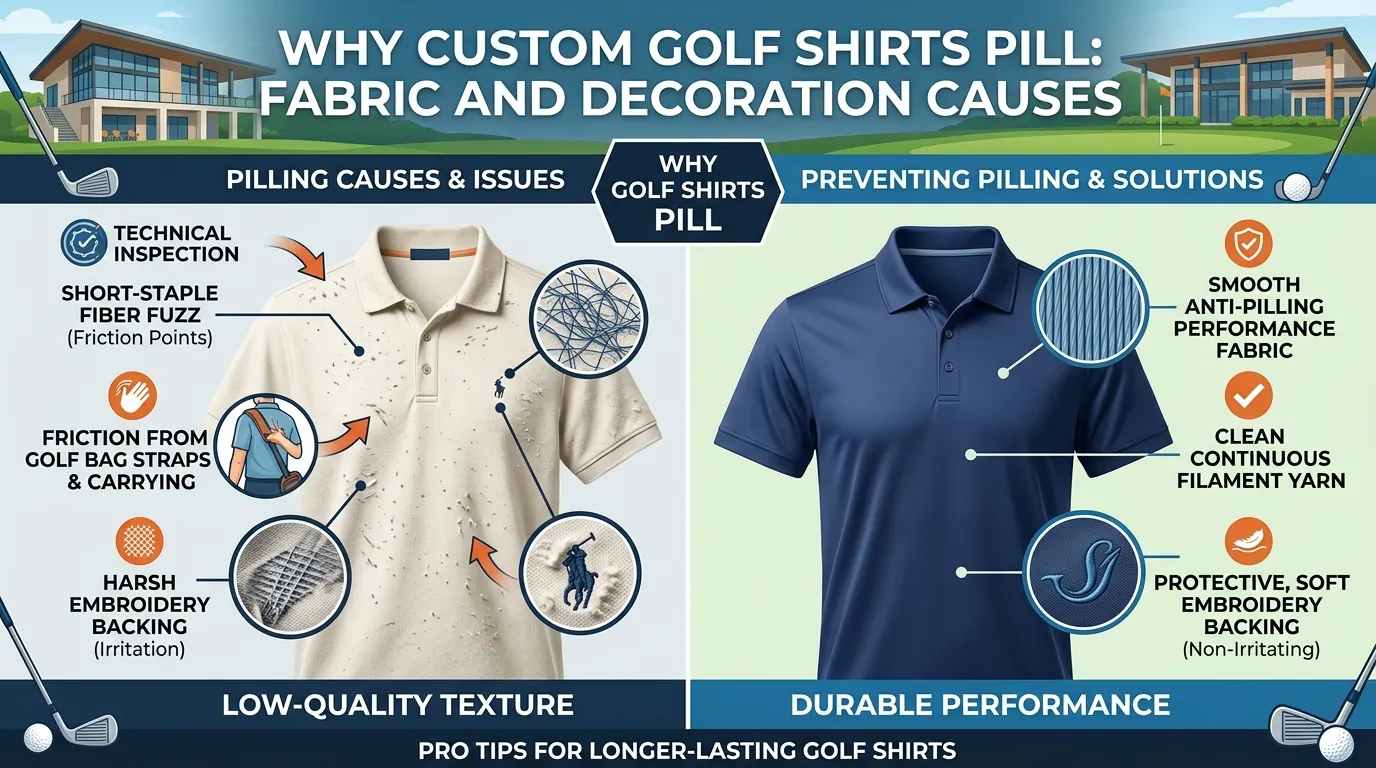
Pilling on a custom golf shirt shows up as tiny fiber balls clustered on the high-friction zones: the bag-strap shoulder area, the lower hem where the shirt rubs the hip, and any panel that touches the chest strap or cart handle. The balls are loose fibers that have worked free from the yarn and tangled together under mechanical stress.
Visible pilling appears within 5 to 10 wash cycles on untreated polyester-cotton blends, on open-end spun yarns, and on shirts embroidered with dense underlay. It is rare on solution-dyed polyester 88 / spandex 12 with a 50 denier filament count, tight-twist combed yarn, and a resin anti-pilling finish tested to grade 4 or higher after 5 washes per ASTM D3512. Pilling is a yarn and finish decision, not a wear-time accident.
2. Root causes
Four controllable variables explain the majority of pilling claims on custom golf polos. They usually appear together rather than alone.
- Open-end spun yarn with a hairiness index above 4.5. Loose fiber ends pill faster than ring-spun or compact-spun yarn. Specify ring-spun or compact-spun combed cotton, or solution-dyed polyester with filament count of 50 denier or finer.
- Yarn twist below 3.8 turns per cm on the weft. Under-twisted yarn loses fiber faster. Hold weft twist at 3.8 to 4.2 turns per cm and warp twist at 4.5 to 5.0 turns per cm on a pique or jersey knit.
- Skip the anti-pilling resin finish. A silicone or acrylic resin finish locks loose fiber ends into the yarn body. Skipping it to save 0.05 to 0.10 USD per shirt is the single biggest cause of early pilling on a new run.
- Dense embroidery underlay on a soft hand fabric. Underlay stitches add friction at the embroidery face. Where the fabric GSM is under 165 gsm, lower the underlay density by 15 to 20 percent and switch to a 40 weight polyester top thread.
3. Diagnosis steps
A repeatable test on a counter sample takes about 90 minutes and predicts the 30-wear result without waiting.
- Run an ASTM D3512 random tumble pilling test for 30 minutes on a pre-conditioned sample. A grade 3 or lower at 30 minutes predicts visible pilling inside 10 wash cycles. Grade 4 or higher after 5 washes is the industry durability line for performance polos.
- Measure yarn hairiness. Use a Zweigle G566 or comparable hairiness meter on the weft. Above 4.5, expect pilling on the lower hem within 10 wears. Below 3.0, the yarn will hold.
- Inspect the embroidery underlay. Count underlay stitches per cm on a reverse-side photo. Above 7 stitches per cm on a sub-165 gsm fabric, expect friction pilling around the embroidery face within 20 wears.
- Verify the resin finish. A 30-second water drop test on the fabric face: an unfinished fabric absorbs the drop in under 5 seconds. A finished fabric holds the drop for 20+ seconds. That single test catches most unfinished runs in the field.
- Test the wash protocol. Wash with the care label at 40 °C and check pilling at the 5th and 10th cycle. If pills appear at the 5th cycle, the resin is under-applied or skipped.
4. Fix or prevent
Three production-side changes remove pilling from the claim list without changing the visual spec.
- Upgrade yarn to ring-spun or compact-spun combed cotton at 3.8 to 4.2 turns per cm weft twist, or solution-dyed polyester 88 / spandex 12 at 50 denier filament count. Both pass ASTM D3512 grade 4 or higher after 5 washes.
- Apply a silicone anti-pilling resin finish at 2.5 to 3.0 percent on weight. The finish locks loose fiber ends. Budget impact is 0.05 to 0.10 USD per shirt; the lifetime-claim reduction is much larger than the cost.
- Reduce embroidery underlay density by 15 to 20 percent on fabrics under 165 gsm, and switch to a 40 weight polyester top thread. The look stays identical, the friction zone drops.
With the three changes combined, the polo holds grade 4 or higher after 5 washes and reaches grade 3.5 or higher after 30 washes on US Standard Fit and EU Slim Fit blocks.
5. Specifications that prevent it
| Parameter | Value | Condition / test |
|---|---|---|
| Collar durability | stays flat 50+ industrial washes | Stay-Flat interlining, reinforced woven interlining + high-density knit |
| 3D silicone logo durability | 60+ washes | tactile raised logo, soft hand feel |
| Shrinkage | under 1.5% after 5 washes | pre-shrunk fabric treatment, US Standard Fit block |
| Pilling resistance | grade 4 or higher after 5 washes | tested per ASTM D3512 (assumed method) |
6. RFQ checklist
Use these questions as your RFQ checklist. A factory that answers all of them in numbers is rare and worth testing:
- What is the MOQ per colorway, and what changes at 50 vs 300 vs 1000 pcs?
- Which certifications are current and verifiable (OEKO-TEX, GRS, BSCI, WRAP, Sedex, REACH)?
- What are the lead times DDP to EU and to US West Coast, contractually?
- What are the shrinkage and colorfastness limits, with test methods?
- What happens to collar shape after 50 industrial washes?
- Ask for a physical sample before PO. Never skip it.
FAQ
Q1. What is the collar durability for Pilling resistance?
stays flat 50+ industrial washes. Stay-Flat interlining, reinforced woven interlining + high-density knit. Confirm the same figure in writing on the tech pack before production.
Q2. Is a sample mandatory before ordering Pilling resistance?
Yes. Fabric hand feel and decoration placement cannot be judged from photos. Order a physical counter sample first; most factories ship one in 3-5 days.
Q3. Does a lower MOQ mean a much higher unit price?
Not always. A factory built for small runs can hold price within a narrow band because its setup cost is low. Ask for the price at 50, 300 and 1000 pcs in one quote.
Q4. How long does production take from PO to delivery?
28-35 days to EU ports under DDP Incoterms, sea to Hamburg / Rotterdam / Felixstowe, from PO confirmation. Express options to the US West Coast are shorter; confirm both at quote time.
Q5. What should I check before signing with a golf apparel factory?
Certification numbers you can verify online, a physical sample, one reference client, and the on-time delivery clause. A factory that hesitates on any of these four is a risk.
Q6. Will collar curling come back after a few washes?
With a stay-flat interlining construction it holds through stays flat 50+ industrial washes. Curling returns when the interlining is thin or the knit density low. That is a spec issue, not a laundry issue.
Related reading
- performance golf polo stretch
- custom golf polo shirts wholesale
- fabric innovation 2026 golf apparel
- blog
Sources
- OEKO-TEX Standard 100
- GRS (Global Recycled Standard)
- BSCI
- WRAP
- Sedex SMETA
- REACH (EU)