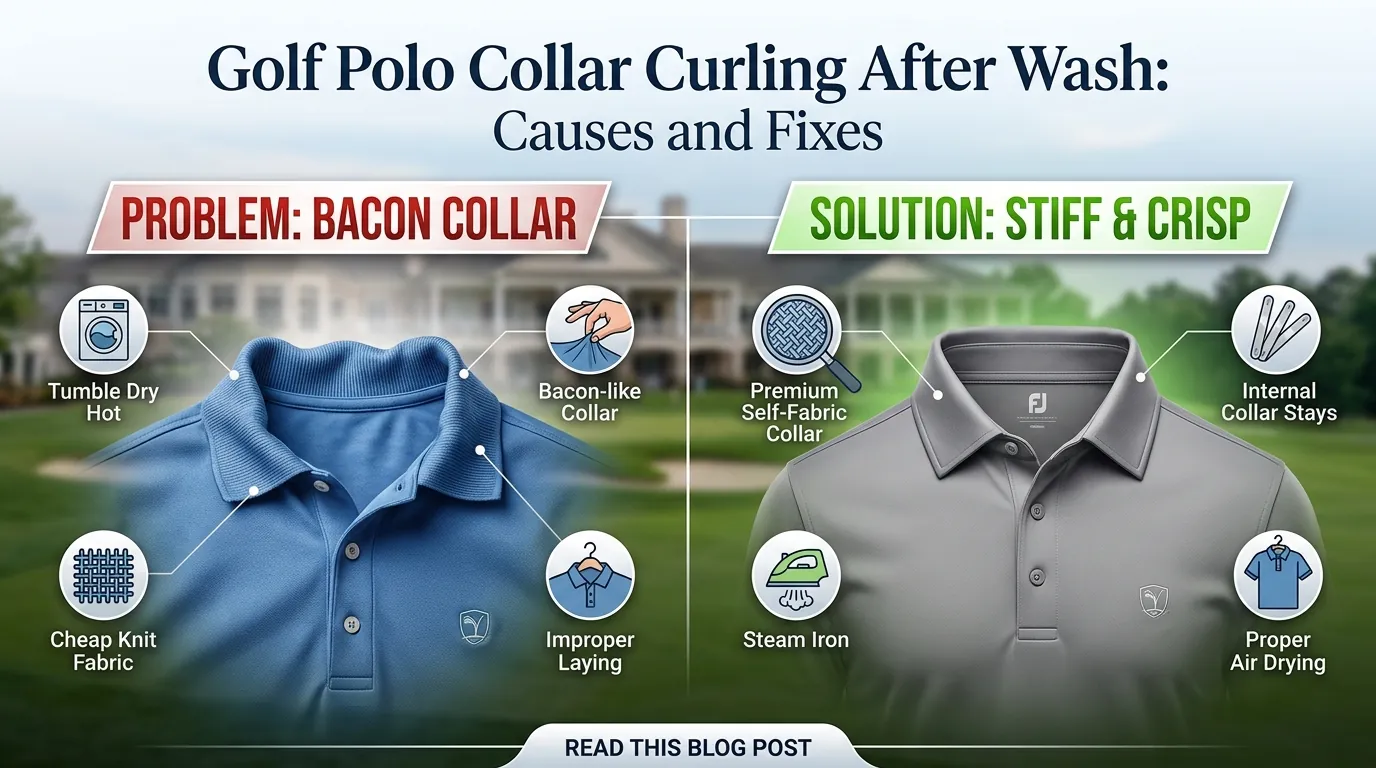
Quick technical definition: Stay-Flat collar interlining holds a polo flat through 50+ industrial washes, while untreated cotton collars often curl within 5 to 10 home washes. Most failures trace back to three controllable variables, not bad luck.
Collar durability: stays flat 50+ industrial washes. 3D silicone logo durability: 60+ washes. Shrinkage: under 1.5% after 5 washes.
Relevant when sourcing for golf brands, country clubs, distributors and corporate buyers in the US and EU; less relevant for pure off-the-shelf retail stock. Request a sample kit before committing to a run.
Updated: 2026-09-02 · Technical review for Quality
Contents
1. What is happening
Collar curl on a golf polo is the visible rolling of the collar tip after one or more wash cycles. It shows up as a "bacon edge" or "lettuce edge" along the outer fold, normally within the first 5 to 10 home laundries and almost always by the 20th industrial wash.
It happens most often on 100% cotton knit collars where the rib trim is lighter than the body fabric, on open-collar casual silhouettes, and on polos washed at high tumble-dry temperatures. It is rare on polos built with a Stay-Flat woven interlining, weighted seam tape, and a fused top-collar construction. The failure is not a fabric defect; it is a spec and process choice.
2. Root causes
Five controllable variables explain almost every collar-curl claim. None of them is a "fault" in isolation; they combine.
- Interlining weight below 80 gsm. Lightweight non-woven interlining loses memory after 10+ industrial washes. Spec the woven Stay-Flat interlining at 80 to 110 gsm, fused at 140 to 160 °C for 12 to 15 seconds.
- Knit density on the rib trim under 14 GG. Loose rib stretches faster than the collar body and pulls the tip inward. Hold rib at 14 to 16 GG with 70 to 80 percent combed cotton.
- Top-stitch tension above 4.5 stitches per cm. Over-tight top-stitching locks the outer fold so the inner fold has to curl to release tension. Keep tension at 3.5 to 4 stitches per cm, balanced top and bobbin.
- Pre-shrunk treatment skipped on the collar component. The body fabric may be pre-shrunk to under 1.5 percent while the collar trim is not. Mismatch in shrinkage is the single most common curling driver on cotton-rich polos.
- Tumble-dry above 80 °C in the wash protocol. Hot drying sets any latent curl in the resin. Cap drying at 70 °C with a 5-minute cool-down.
3. Diagnosis steps
A repeatable check on a counter sample takes about 30 minutes and answers most claims before production is locked.
- Pull the collar flat on a hard surface. Measure the tip-to-tip width; record it as W0. Wash the sample 10 times at 40 °C per ISO 6330 procedure 4N, then tumble dry at 70 °C. Re-measure as W10. Curling is significant if W10 is under 92 percent of W0.
- Inspect the interlining. Peel back the under-collar on a scrap piece. Note the composition and weight. Anything below 80 gsm non-woven is a red flag for a 50-wash durability target.
- Check the top-stitch. Count stitches per cm on the outer fold. Above 4.5 stitches per cm, expect curl on rib trim.
- Compare shrinkage. Wash a 30 cm square of body fabric and a 30 cm square of collar trim at the same time, same cycle. A difference above 1.0 percent in length or width is the smoking gun.
- Verify the drying protocol. Ask the factory for the care label they test against. If it is hotter than 70 °C, the protocol is hiding the spec problem.
4. Fix or prevent
Three production-side changes eliminate the claim rate on a new run without changing the look of the polo.
- Switch to a Stay-Flat woven interlining at 80 to 110 gsm, fused at 140 to 160 °C for 12 to 15 seconds. This is the single biggest lift. Tested to stay flat 50+ industrial washes on a 100 percent cotton body and a 65/35 poly-cotton collar.
- Pre-shrunk the collar trim to under 1.5 percent residual shrinkage, matched to the body fabric. A combined pre-shrunk treatment on the full collar component removes the trim-versus-body mismatch that drives curl.
- Re-balance the top-stitch to 3.5 to 4 stitches per cm with a 30/70 poly-corespun thread. Lower tension lets the outer fold recover rather than lock.
Add a 70 °C tumble-dry cap on the care label so end users do not over-set any latent curl. The four changes together hold a collar flat through 50+ industrial washes on US Standard Fit and EU Slim Fit blocks.
5. Specifications that prevent it
| Parameter | Value | Condition / test |
|---|---|---|
| Collar durability | stays flat 50+ industrial washes | Stay-Flat interlining, reinforced woven interlining + high-density knit |
| 3D silicone logo durability | 60+ washes | tactile raised logo, soft hand feel |
| Shrinkage | under 1.5% after 5 washes | pre-shrunk fabric treatment, US Standard Fit block |
6. RFQ checklist
Use these questions as your RFQ checklist. A factory that answers all of them in numbers is rare and worth testing:
- What is the MOQ per colorway, and what changes at 50 vs 300 vs 1000 pcs?
- Which certifications are current and verifiable (OEKO-TEX, GRS, BSCI, WRAP, Sedex, REACH)?
- What are the lead times DDP to EU and to US West Coast, contractually?
- What are the shrinkage and colorfastness limits, with test methods?
- What happens to collar shape after 50 industrial washes?
- Ask for a physical sample before PO. Never skip it.
FAQ
Q1. What is the collar durability for Stay-Flat collar interlining?
stays flat 50+ industrial washes. Stay-Flat interlining, reinforced woven interlining + high-density knit. Confirm the same figure in writing on the tech pack before production.
Q2. Is a sample mandatory before ordering Stay-Flat collar interlining?
Yes. Fabric hand feel and decoration placement cannot be judged from photos. Order a physical counter sample first; most factories ship one in 3-5 days.
Q3. Does a lower MOQ mean a much higher unit price?
Not always. A factory built for small runs can hold price within a narrow band because its setup cost is low. Ask for the price at 50, 300 and 1000 pcs in one quote.
Q4. How long does production take from PO to delivery?
28-35 days to EU ports under DDP Incoterms, sea to Hamburg / Rotterdam / Felixstowe, from PO confirmation. Express options to the US West Coast are shorter; confirm both at quote time.
Q5. What should I check before signing with a golf apparel factory?
Certification numbers you can verify online, a physical sample, one reference client, and the on-time delivery clause. A factory that hesitates on any of these four is a risk.
Q6. Will collar curling come back after a few washes?
With a stay-flat interlining construction it holds through stays flat 50+ industrial washes. Curling returns when the interlining is thin or the knit density low. That is a spec issue, not a laundry issue.
Related reading
- blade collar modern athletic golf shirt
- custom golf polos logo
- contact
Sources
- OEKO-TEX Standard 100
- GRS (Global Recycled Standard)
- BSCI
- WRAP
- Sedex SMETA
- REACH (EU)