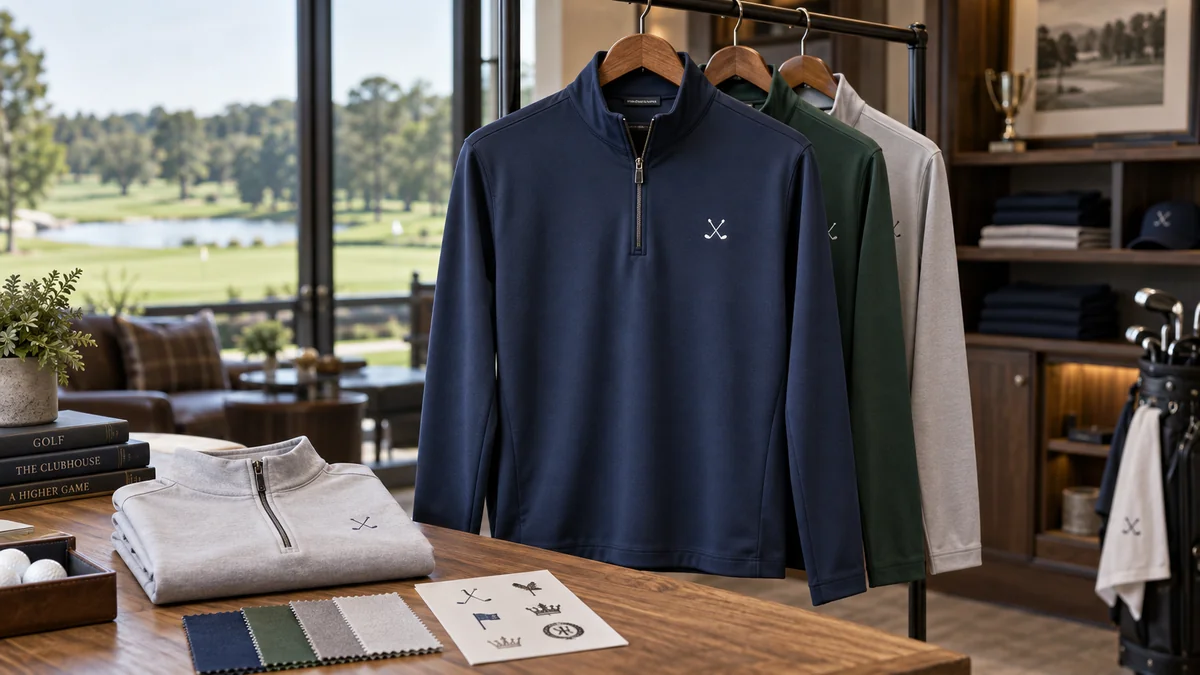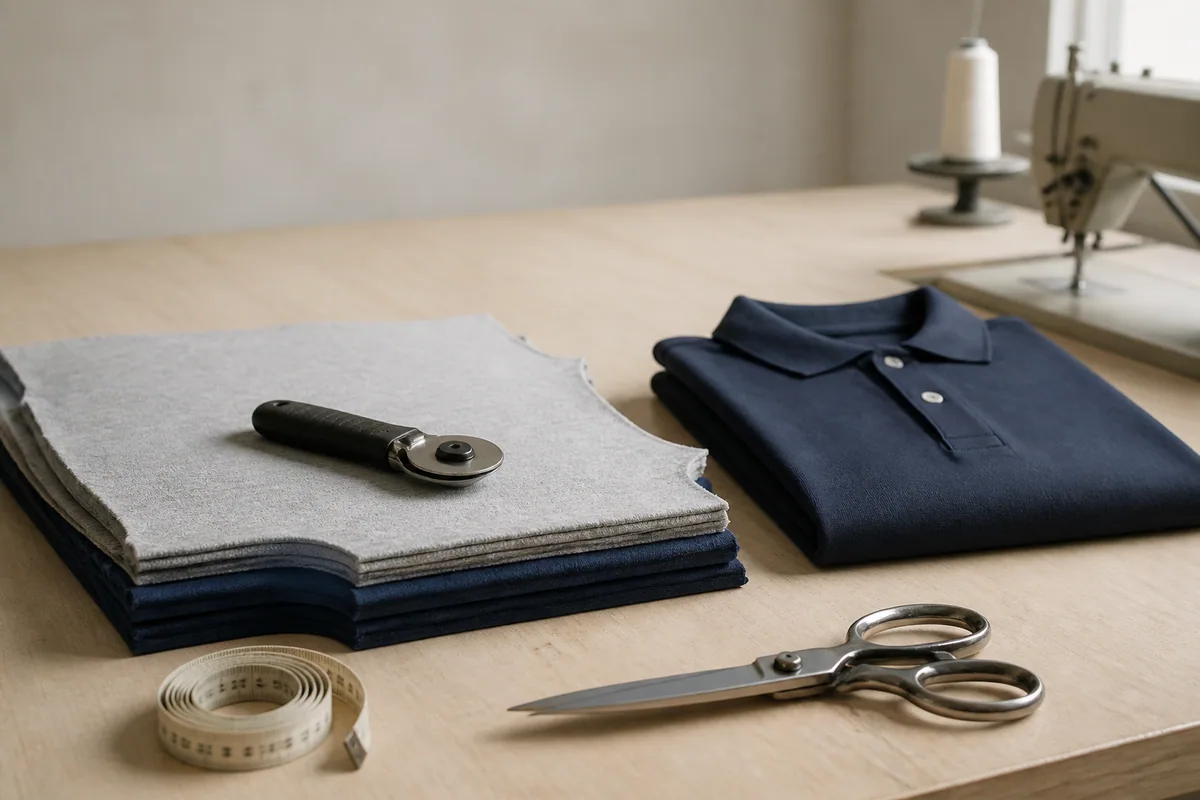
Short answer: at small volume you are mostly paying for setup, not for garments. Sampling, decoration setup, fabric minimums and QC are largely fixed, so the first 50-piece run of a style carries a premium that the second run of the same style does not. Order the first run in a shape that makes the second one cheap.
Updated: 2026-09-19 · Technical review for Business
1. What "small batch" means in practice
Small batch is a real manufacturing category, not a marketing phrase. In custom golf apparel it usually means 50–100 pcs per colorway, produced from fabric that either already exists or has a low enough minimum to be worth cutting.
The important unit here is the colorway, not the total order. A 300-piece order split across six colourways is six small runs, and it will be priced as six small runs. An order of 100 pieces in one colourway is one run and prices accordingly. This single distinction explains most of the surprise in quotations, and it is the first thing to check when you compare suppliers.
2. The four costs that dominate a small run
- Sampling. A pre-production sample of your actual artwork on your actual fabric. You pay for the sample itself and for the fact that the line stops to make it. Sampling is where the design gets de-risked — it is the cheapest place to find a mistake.
- Decoration setup. Embroidery needs your logo digitised into a stitch file that runs correctly on fabric that stretches. Print needs artwork separated and, for screen print, a screen per colour. Heat transfer needs a transfer produced and tested. In every method this is a one-time cost attached to the artwork, not to the quantity.
- Fabric minimums. Fabric is ordered by the roll or by weight. Below a certain quantity your order does not use a whole roll, and you either pay for the remainder or pay a cutting fee. Choosing a fabric that a factory already stocks, or that is already running for another customer, removes this almost entirely.
- QC time. Inspection is charged in hours. A 50-piece order still needs the line set up, the first-off approved and the finished goods measured and checked. This is the one cost that genuinely scales.
Notice that the first three do not care much whether you order 50 or 500. That is the entire reason a small batch costs more per unit.
3. Why the unit price falls as volume rises
Fixed costs spread over more units. If setup amounts to a few hundred dollars and you make 50 pieces, that setup is a meaningful share of every garment. Make 500 and the same setup is a rounding error. The garment cost itself barely changes — the material and labour inputs are roughly linear.
This is also why the second run of an identical style is cheaper than the first. The digitised logo exists. The approved sample exists. The colour and fabric are on file. You are paying for garments, not for setup, so the per-unit price drops towards the mass-production rate without you changing anything about the order.
4. How to reduce the small-batch premium
- Consolidate colourways. Three colourways at 100 pieces each is far better value than six at 50. If you need range for launch, consider launching three and adding three in the second run.
- Use stock fabric. Ask what the factory is already running this season. A fabric with an existing production slot avoids both the minimum and the lead time.
- Keep decoration simple. Standard embroidery or sublimation avoids screens. Each extra print colour is another screen, another setup and another failure point.
- Reuse the artwork. Once a logo is digitised it is yours; ask that the stitch file and artwork be archived against your account so the second order starts from a known-good state.
- Order the second run before you run out. A repeat order planned while the first is still in season avoids rush fees and lets the factory slot it into an existing production window.
5. The calendar to plan against
- Pre-production sample: 7–10 days from artwork approval
- Sample approval and any revision: allow a week, more if you have a committee
- Bulk production: 30–35 days after sample approval
- Plus international freight and customs clearance on top of that
The two places buyers lose a week are artwork approval (waiting on their own brand owner) and sample feedback (waiting on someone to physically open the parcel). Both are inside your control and both are free to fix.
6. Before you commit
- How many colourways, and how many pieces in each? (Count the colourways, not the total.)
- Is the fabric stock or made-to-order? If made-to-order, what is the minimum?
- Is the decoration artwork already digitised or separated?
- Who approves the sample, and by when?
- What is the reorder price for the same specification?
That last question is the one worth asking first. A supplier who cannot quote a reorder price is telling you the first order is the only one they have planned for.
7. FAQ
Is 50 pieces really possible? Yes, 50 pcs per colorway with standard embroidery or sublimation. What makes it possible is that the fabric is stock and the decoration is a single setup, not that the factory is doing something unusual.
Why is my 50-piece order more expensive per unit than a 500-piece order? Because setup is fixed. Sampling, digitising, fabric minimums and QC setup do not shrink with the order, so spreading them over 50 units costs more per garment than spreading them over 500.
Can I get a cheaper first order by skipping the sample? You can, and it is usually a false economy. The sample is where the logo size, the placement and the fabric behaviour get confirmed. Finding a mistake at sample stage costs one garment; finding it at bulk stage costs the run.
Does mixing colourways in one order reduce the price? Not usually, and it can raise it, because each colourway carries its own cutting and its own minimum. Consolidating colourways lowers the unit price far more reliably than adding them.
What is the minimum for a custom programme? At Mega Elephant, 50 pcs per colorway with standard embroidery or sublimation. Samples 7–10 days; bulk production 30–35 days after sample approval.
Sources
- Mega Elephant production specification (live spec sheet, 2026-09)
- OEKO-TEX Standard 100 — product class II
- GRS (Global Recycled Standard)
- BSCI, Sedex SMETA