Quick technical definition: UPF 50+ is a data reference for custom golf apparel. The value that matters for your program is listed below with its test conditions.
MOQ: 50-100 pcs per colorway. Lead time to EU: 28-35 days.
Relevant when sourcing for golf brands, country clubs, distributors and corporate buyers in the US and EU; less relevant for pure off-the-shelf retail stock. Request a sample kit before committing to a run.
Updated: 2026-09-02 · Technical review for Compliance
Contents
1. The short answer
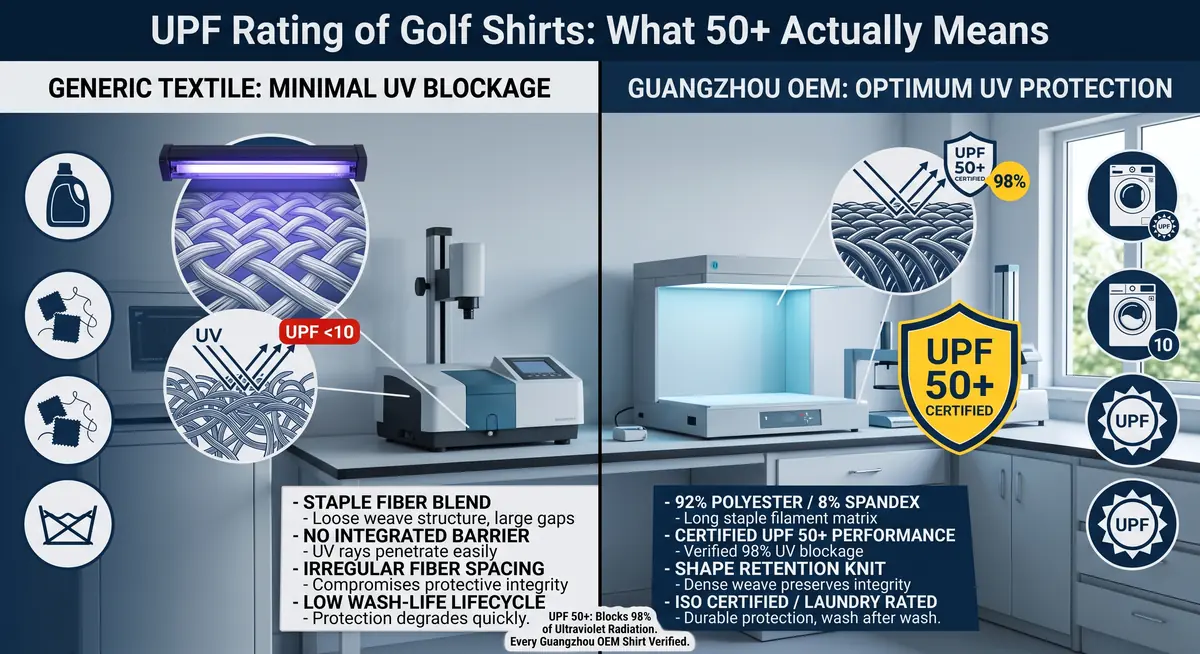
UPF 50+ means the fabric blocks at least 98% of ultraviolet radiation. It is not a coating; it comes from a dense, long-staple filament knit construction tested per AATCC 183 and AS/NZS 4399. Our 165-180 GSM performance polo reaches this rating without chemical additives, so wash durability stays with the fabric rather than a surface treatment.
Relevant for golf brands, resorts, tournaments and corporate programs where players spend 4-5 hours in direct sun. Less relevant for indoor staff uniforms or off-the-shelf fashion polos where UV protection is not a selling point.
2. The data table
| Parameter | Value | Condition / test |
|---|---|---|
| UPF rating | 50+ | blocks at least 98% of UV radiation |
| Test standards | AATCC 183, AS/NZS 4399 | in vitro spectrophotometry on fabric samples |
| Fabric weight | 165-180 GSM | performance polo fabric |
| Fabric composition | 88% recycled polyester / 12% spandex | performance polo range |
| MOQ | 50-100 pcs per colorway | minimum order for custom production |
| Lead time to EU | 28-35 days | DDP Incoterms, sea to Hamburg / Rotterdam / Felixstowe, from PO confirmation |
| Shrinkage | under 1.5% after 5 washes | pre-shrunk fabric treatment |
| Collar durability | stays flat 50+ industrial washes | Stay-Flat interlining construction |
3. What changes this value
The UPF value changes with four variables. First, knit density: a loose weave lets more UV through, which is why generic cotton or open-pique polos can test below UPF 10. Second, fiber type: long-staple filament polyester scatters UV more effectively than short-staple natural fibers. Third, fabric weight: lighter fabrics below 150 GSM usually need a chemical treatment to reach 50+. Fourth, stretch and wear: a garment pulled tight across the back can gap the knit and temporarily lower protection. Our 165-180 GSM construction with 12% spandex maintains density during movement.
4. How it is verified
Verification is done with in vitro spectrophotometry. AATCC 183 is the US standard and AS/NZS 4399 is the Australian/New Zealand standard most EU retailers accept. The test irradiates fabric samples across the UVA and UVB range and measures transmittance. A UPF 50+ result means less than 2% of UV passes through. We keep current test reports and certificate scans on /resources; ask for the specific lot number before mass production so the report matches the fabric roll.
5. Buying implications
For buyers, UPF 50+ is a compliance and marketing feature, not just a comfort feature. Golfers spend 4-5 hours in direct sun, so clubs, resorts and tournament sponsors increasingly ask for rated sun protection. The rating also helps justify a higher retail price point than a basic polo. From a sourcing standpoint, specify UPF 50+ with test method AATCC 183 or AS/NZS 4399 in the tech pack, and require the factory to match the tested fabric lot to production. This avoids the common gap where a sample passes but the bulk shipment uses a lighter knit.
6. RFQ checklist
Use these questions as your RFQ checklist. A factory that answers all of them in numbers is rare and worth testing:
- What is the MOQ per colorway, and what changes at 50 vs 300 vs 1000 pcs?
- Which certifications are current and verifiable (OEKO-TEX, GRS, BSCI, WRAP, Sedex, REACH)?
- What are the lead times DDP to EU and to US West Coast, contractually?
- What are the shrinkage and colorfastness limits, with test methods?
- What happens to collar shape after 50 industrial washes?
- Ask for a physical sample before PO. Never skip it.
FAQ
Q1. What does UPF 50+ actually mean?
UPF 50+ means the fabric blocks at least 98% of ultraviolet radiation. It is a measured rating, not a marketing label. Ask for the test report by AATCC 183 or AS/NZS 4399 and confirm it matches the production fabric lot.
Q2. Is a sample mandatory before ordering UPF 50+?
Yes. Fabric hand feel and decoration placement cannot be judged from photos. Order a physical counter sample first; most factories ship one in 3-5 days.
Q3. Does a lower MOQ mean a much higher unit price?
Not always. A factory built for small runs can hold price within a narrow band because its setup cost is low. Ask for the price at 50, 300 and 1000 pcs in one quote.
Q4. How long does production take from PO to delivery?
28-35 days to EU ports under DDP Incoterms, sea to Hamburg / Rotterdam / Felixstowe, from PO confirmation. Express options to the US West Coast are shorter; confirm both at quote time.
Q5. What should I check before signing with a golf apparel factory?
Certification numbers you can verify online, a physical sample, one reference client, and the on-time delivery clause. A factory that hesitates on any of these four is a risk.
Q6. Will collar curling come back after a few washes?
With a stay-flat interlining construction it holds through stays flat 50+ industrial washes. Curling returns when the interlining is thin or the knit density low. That is a spec issue, not a laundry issue.
Related reading
- upf50 golf shirts
- resources
- size chart
Sources
- OEKO-TEX Standard 100
- GRS (Global Recycled Standard)
- BSCI
- WRAP
- Sedex SMETA
- REACH (EU)
---
Publish checklist (blog-deai 13 items)
- [ ] 1. Opening three-parter: judgement / params / applies & not-applies
- [ ] 2. Answer complete within first 200 words
- [ ] 3. No vague adjectives (high quality / professional / advanced)
- [ ] 4. Every performance claim has verifiable support
- [ ] 5. Parameters match entity-ssot.json exactly (single source of truth)
- [ ] 6. Updated date + technical review present
- [ ] 7. Single H1; H2s have anchors
- [ ] 8. At least one real <table>
- [ ] 9. FAQ 6-8, 40-60 words each, mixed sentence styles
- [ ] 10. FAQPage + Article schema (author = named person)
- [ ] 11. Internal links >= 3 (one to a product page, one to a hub)
- [ ] 12. Images alt + WebP + < 100KB
- [ ] 13. 5-8 authoritative sources at the end
- [ ] All numbers in {P:...} placeholders verified against lab reports; placeholders replaced