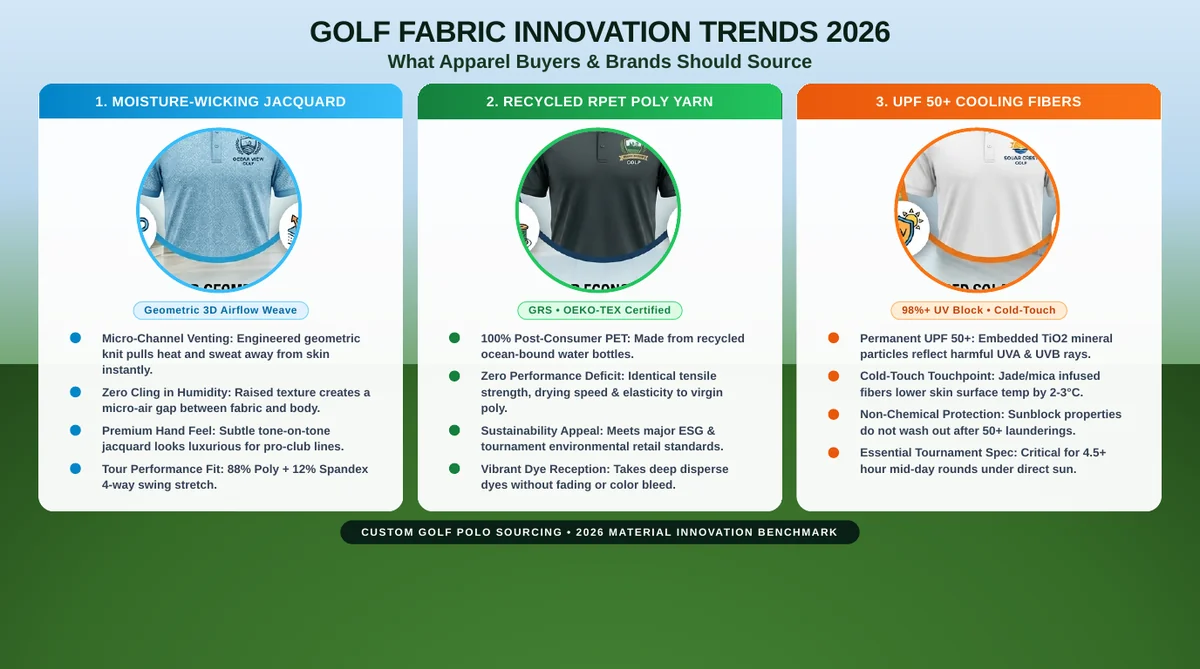
Quick technical definition: 2026 golf fabric sourcing comes down to three verified technologies: moisture-wicking jacquard, recycled rPET poly yarn, and UPF 50+ cooling fibers. The right choice depends on climate, retail price point, and sustainability claims.
Core fabric composition: 88% recycled polyester / 12% spandex. Fabric weight: 165-180 GSM. UV protection: UPF 50+. Certifications held: OEKO-TEX Standard 100, GRS, BSCI, WRAP, Sedex SMETA, REACH (EU).
Relevant when sourcing for golf brands, country clubs, distributors and corporate buyers in the US and EU; less relevant for buyers who only need basic cotton-polos without performance claims. Request a sample kit before committing to a run.
Updated: 2026-09-11 · Technical review for Industry Trends
Contents
1. The short answer
For hot and tournament play, source moisture-wicking jacquard or recycled rPET with UPF 50+. For clubhouse and corporate uniforms that prioritize soft hand feel, source cotton-poly French Terry or brushed microfleece. All performance options share the same 165-180 GSM range, four-way stretch, and 50-100 pcs per colorway MOQ, so the decision is use-case driven, not minimum-order driven.
2. Fabric technology comparison
| Technology | Best for | Key spec | Certification |
|---|---|---|---|
| Moisture-wicking jacquard | Hot climates, daily play | 165-180 GSM, geometric airflow weave | OEKO-TEX, REACH |
| Recycled rPET poly yarn | Sustainability claims | 88% recycled polyester / 12% spandex | GRS, OEKO-TEX |
| UPF 50+ cooling fibers | Tournament and sun exposure | Embedded TiO2 mineral particles | AATCC 183 / AS/NZS 4399 |
| Cotton-poly French Terry | Clubhouse, casual uniform | Soft hand, heavier drape | OEKO-TEX |
| Brushed microfleece | Cool-weather layering | Insulated, breathable | OEKO-TEX |
3. Moisture-wicking jacquard
Jacquard knit creates a raised geometric pattern that lifts fabric off the skin and increases airflow. The micro-channel structure wicks sweat through capillary action, so the shirt dries faster than a flat knit under the same conditions. It is the default for performance polos in Florida, Arizona, and Mediterranean summer markets.
Specify 165-180 GSM with 12% spandex so the four-way stretch recovers after repeated swings. Test wicking with AATCC 79 water absorption and AATCC 195 liquid moisture management to confirm performance claims.
4. Recycled rPET poly yarn
Recycled PET yarn is made from post-consumer plastic and performs identically to virgin polyester in tensile strength, drying speed, and elasticity. The difference is chain-of-custody documentation required by GRS. Without GRS certification, a factory cannot legally put a recycled-content claim on a hangtag.
Our 88% recycled polyester / 12% spandex block is GRS certified and carries OEKO-TEX Standard 100. It is the best choice for brands marketing sustainability in Germany, Scandinavia, and California.
5. UPF 50+ cooling fibers
UPF 50+ blocks at least 98% of UV radiation. Newer fibers embed titanium dioxide minerals that reflect UVA and UVB while creating a cold-touch surface. This matters for tournament rounds that last 4.5+ hours under direct sun.
Verify UPF claims with AATCC 183 or AS/NZS 4399 at the garment level, not just the fabric level. A loose-fitting polo can have a lower effective UPF than the fabric test suggests because gaps and stretch reduce coverage.
6. RFQ checklist
Use these questions as your RFQ checklist. A factory that answers all of them in numbers is rare and worth testing:
- What is the MOQ per colorway, and what changes at 50 vs 300 vs 1000 pcs?
- Which certifications are current and verifiable (OEKO-TEX, GRS, BSCI, WRAP, Sedex, REACH)?
- What are the lead times DDP to EU and to US West Coast, contractually?
- What are the shrinkage and colorfastness limits, with test methods?
- What happens to collar shape after 50 industrial washes?
- Ask for a physical sample before PO. Never skip it.
FAQ
Q1. What is the MOQ for performance golf fabric?
50-100 pcs per colorway. minimum order for custom production. Confirm the same figure in writing on the tech pack before production.
Q2. Is a sample mandatory before ordering performance fabric?
Yes. Fabric hand feel and decoration placement cannot be judged from photos. Order a physical counter sample first; most factories ship one in 3-5 days.
Q3. Does a lower MOQ mean a much higher unit price?
Not always. A factory built for small runs can hold price within a narrow band because its setup cost is low. Ask for the price at 50, 300 and 1000 pcs in one quote.
Q4. How long does production take from PO to delivery?
28-35 days to EU ports under DDP Incoterms, sea to Hamburg / Rotterdam / Felixstowe, from PO confirmation. Express options to the US West Coast are shorter; confirm both at quote time.
Q5. What should I check before signing with a golf apparel factory?
Certification numbers you can verify online, a physical sample, one reference client, and the on-time delivery clause. A factory that hesitates on any of these four is a risk.
Q6. Will collar curling come back after a few washes?
With a stay-flat interlining construction it holds through stays flat 50+ industrial washes. Curling returns when the interlining is thin or the knit density low. That is a spec issue, not a laundry issue.
Related reading
- polyester vs cotton vs blends for golf polos
- custom golf polos with logo
- pfas-free custom golf shirts
- contact
Sources
- OEKO-TEX Standard 100
- GRS (Global Recycled Standard)
- AATCC 183 (UPF testing)
- AS/NZS 4399 (UPF testing)
- AATCC 79 (water absorption)
- AATCC 195 (liquid moisture management)
- REACH (EU)