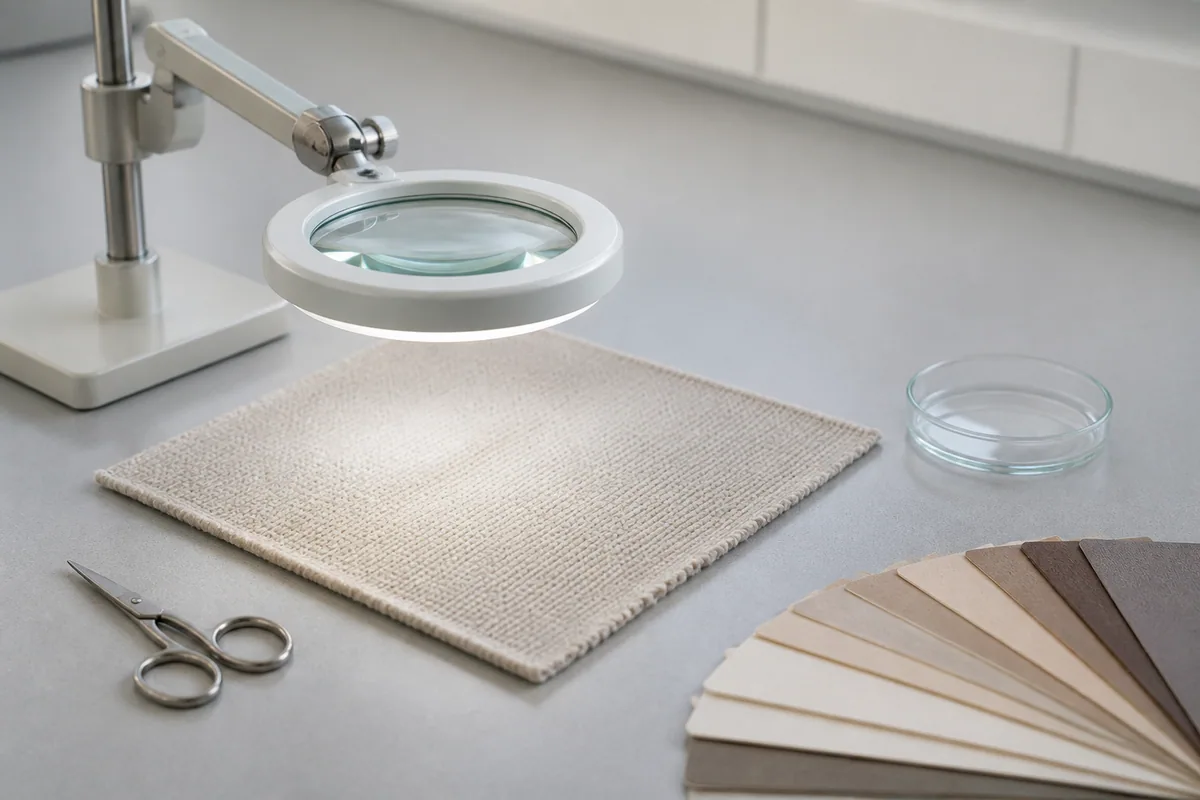
Short answer: "OEKO-TEX certified" is not one claim — OEKO-TEX publishes several standards for different things. For a golf polo that touches the skin, the relevant one is STANDARD 100, product class II. Every real certificate has a number you can check yourself on the OEKO-TEX label check, so treat any certificate you have not verified as unverified.
Updated: 2026-09-19 · Technical review for Business
1. Which OEKO-TEX standard you actually want
The name gets used loosely, and the standards answer different questions:
- STANDARD 100 — the finished article, tested for harmful substances. This is the one buyers usually mean.
- ECO PASSPORT — the chemicals and dyestuffs used in production. Relevant to your mill, not to your garment.
- STeP — a production facility, assessed on environmental and social management.
- MADE IN GREEN — a traceable product label that combines a STANDARD 100 article with STeP-assessed production.
- DETOX TO ZERO — wastewater and sludge management at a facility.
A supplier who says "we are OEKO-TEX certified" and cannot name which standard has given you a logo, not a fact.
2. Product class II is the one that applies
STANDARD 100 classifies articles by how much skin contact they get:
- Class I — articles for babies and toddlers
- Class II — articles worn next to the skin, covering most of the body
- Class III — articles worn away from the skin
- Class IV — furnishing and decoration materials
A golf polo is worn directly against the torso for four hours at a time, so it belongs in class II. If a supplier shows you a class III certificate for the same fabric and calls it equivalent, it is not: the limit values are stricter in class II.
Two limits worth knowing about, because they come up in tenders. Class II restricts formaldehyde and it restricts azo colourants that can cleave into carcinogenic amines. Ask for the specific test report, not just the certificate cover page.
3. How to verify a certificate in about two minutes
This is the part most buyers skip, and it is the easiest control you have.
- Ask for the certificate number and the issuing institute (for example Hohenstein, TESTEX, IFTH).
- Check the number on the OEKO-TEX label check on the official OEKO-TEX site.
- Confirm the certificate holder is the company you are actually buying from, not a mill three tiers away.
- Confirm the validity date. STANDARD 100 certificates are time-limited and must be renewed; an expired certificate that is still being circulated is common.
- Confirm the product scope covers your fabric and article category.
If any of those five do not line up — the holder, the scope, or the date — you do not have a verified claim, however professional the PDF looks.
4. What OEKO-TEX does not tell you
This is where due diligence usually breaks. OEKO-TEX is a product safety scheme. It says nothing about wages, working hours, freedom of association, building safety or sub-contracting.
Those sit with the social audit programmes — BSCI, Sedex SMETA and WRAP — which are a separate body of evidence. A supplier can be genuinely STANDARD 100 certified and still fail a social audit. Buyers who accept one as proof of the other have an unexamined gap in their supply chain, and that gap is exactly what an NGO or a journalist will find.
The clean way to hold it: keep two files per supplier. One for product compliance (OEKO-TEX, REACH, and any restricted substance list your brand uses). One for social compliance (BSCI or SMETA reports, corrective action plans, expiry dates). They answer different questions and neither substitutes for the other.
5. Five questions to send your supplier
- Which OEKO-TEX standard and product class applies to this article?
- What is the certificate number and who issued it?
- Is the certificate holder the same legal entity that will invoice us?
- When does it expire, and what is the renewal process?
- Can you provide the test report for the specific fabric we are ordering, not a generic one?
6. FAQ
Is OEKO-TEX the same as a social audit? No. OEKO-TEX covers harmful substances in the product and, in some standards, the facility's processes. Labour practices are covered by BSCI, Sedex SMETA or WRAP.
Does an OEKO-TEX certificate cover our specific order? Only if the product scope in the certificate covers the fabric and article category you are buying. Always match the scope, not just the company name.
Can a factory use a mill's certificate? A mill's STANDARD 100 certificate tells you the fabric was tested. It does not certify the garment, and it does not make the garment supplier a certificate holder. If your buyer's compliance team requires the garment certified, you need a certificate in the garment maker's name.
What about REACH? REACH is EU chemicals legislation and applies regardless of OEKO-TEX. Most buyers want both, and the two answer different questions — REACH is a legal obligation, OEKO-TEX is a voluntary product mark with defined limit values.
What is the minimum order for a custom programme? At Mega Elephant, 50 pcs per colorway with standard embroidery or sublimation. Samples 7–10 days; bulk production 30–35 days after sample approval.
Sources
- OEKO-TEX — STANDARD 100, ECO PASSPORT, STeP, MADE IN GREEN, DETOX TO ZERO
- OEKO-TEX label check (certificate verification)
- REACH (EU) — restricted substances in textiles
- amfori BSCI, Sedex SMETA, WRAP
- GRS (Global Recycled Standard)