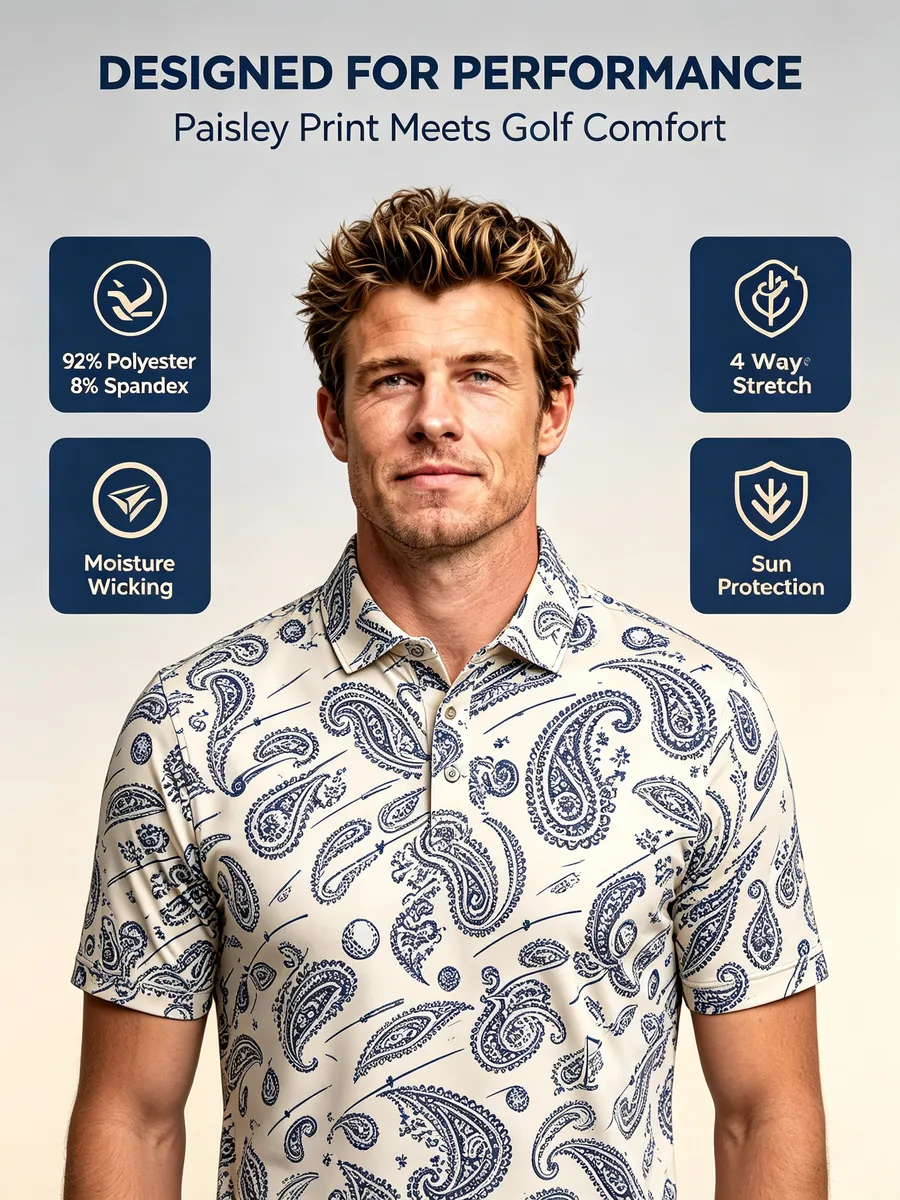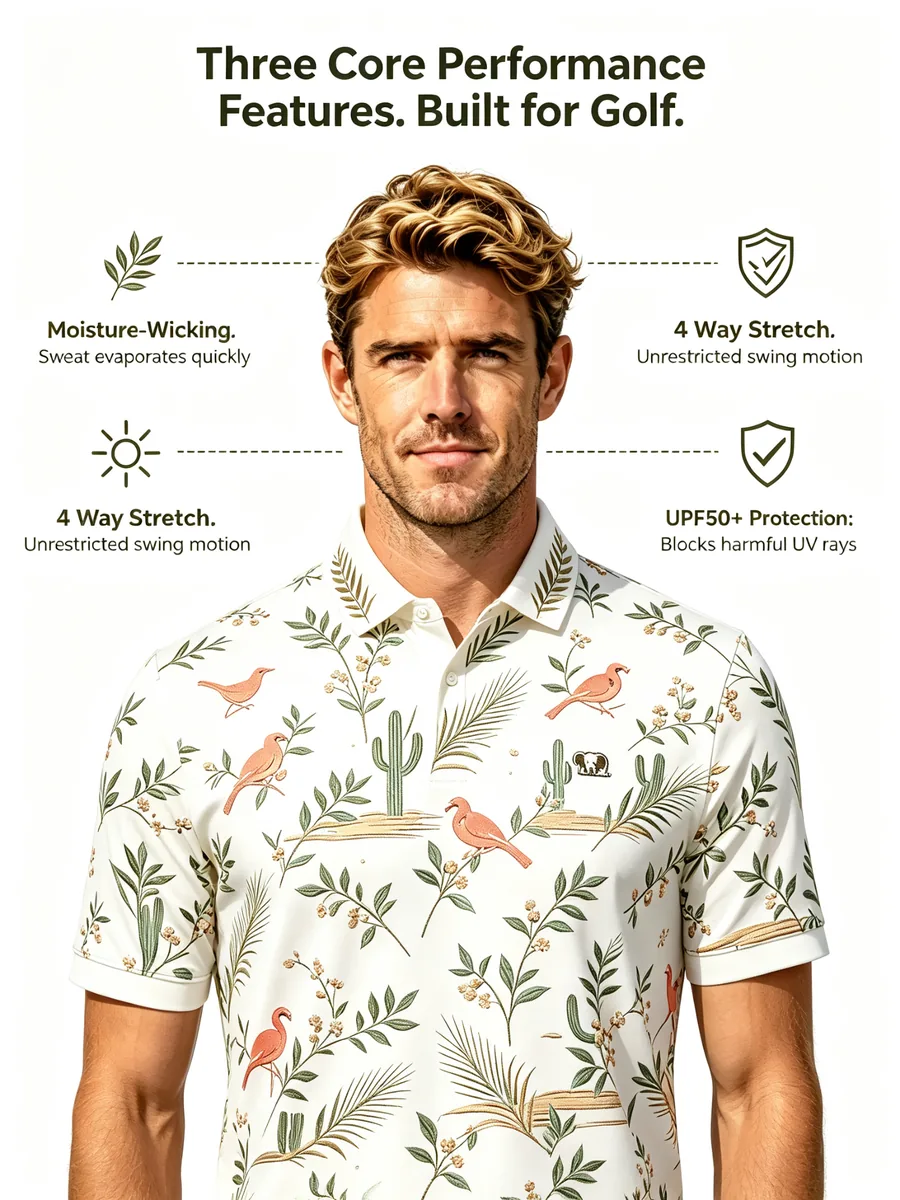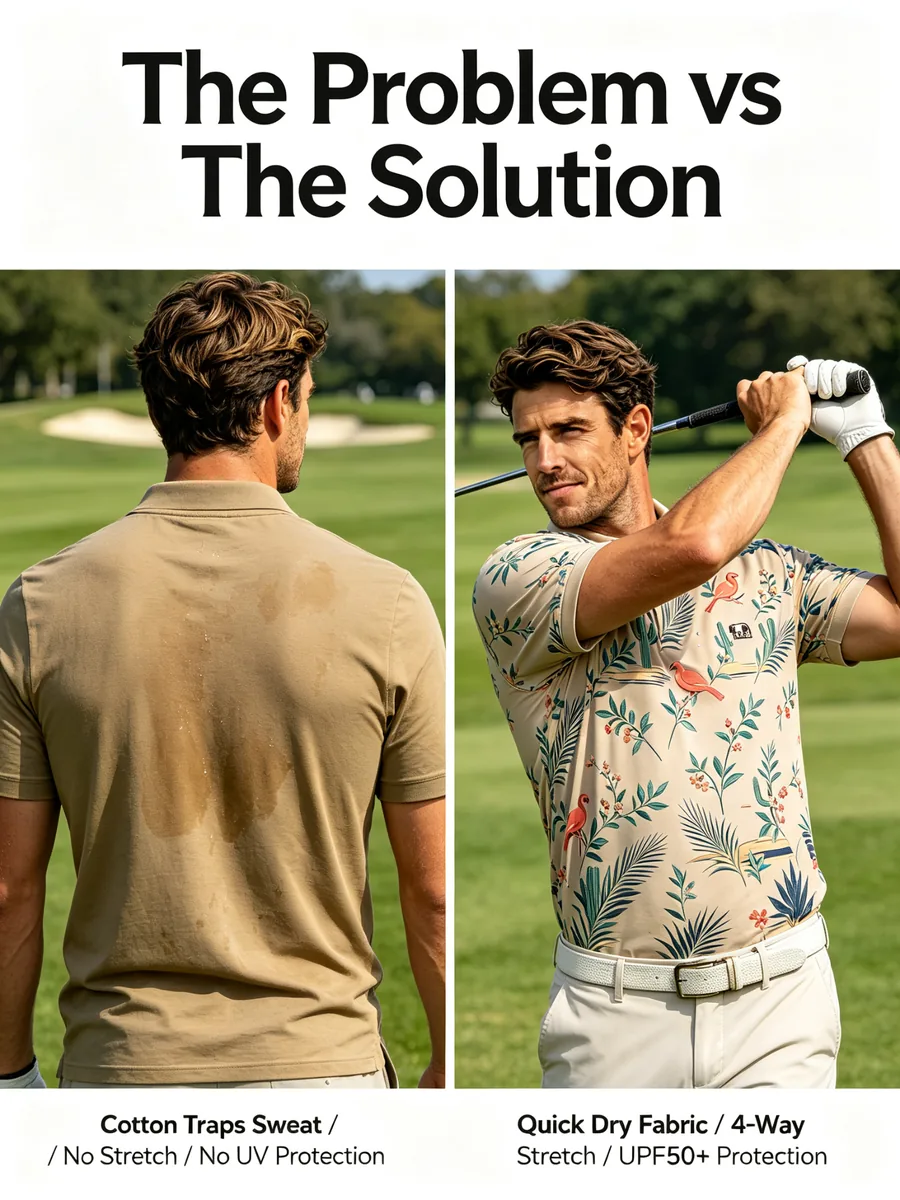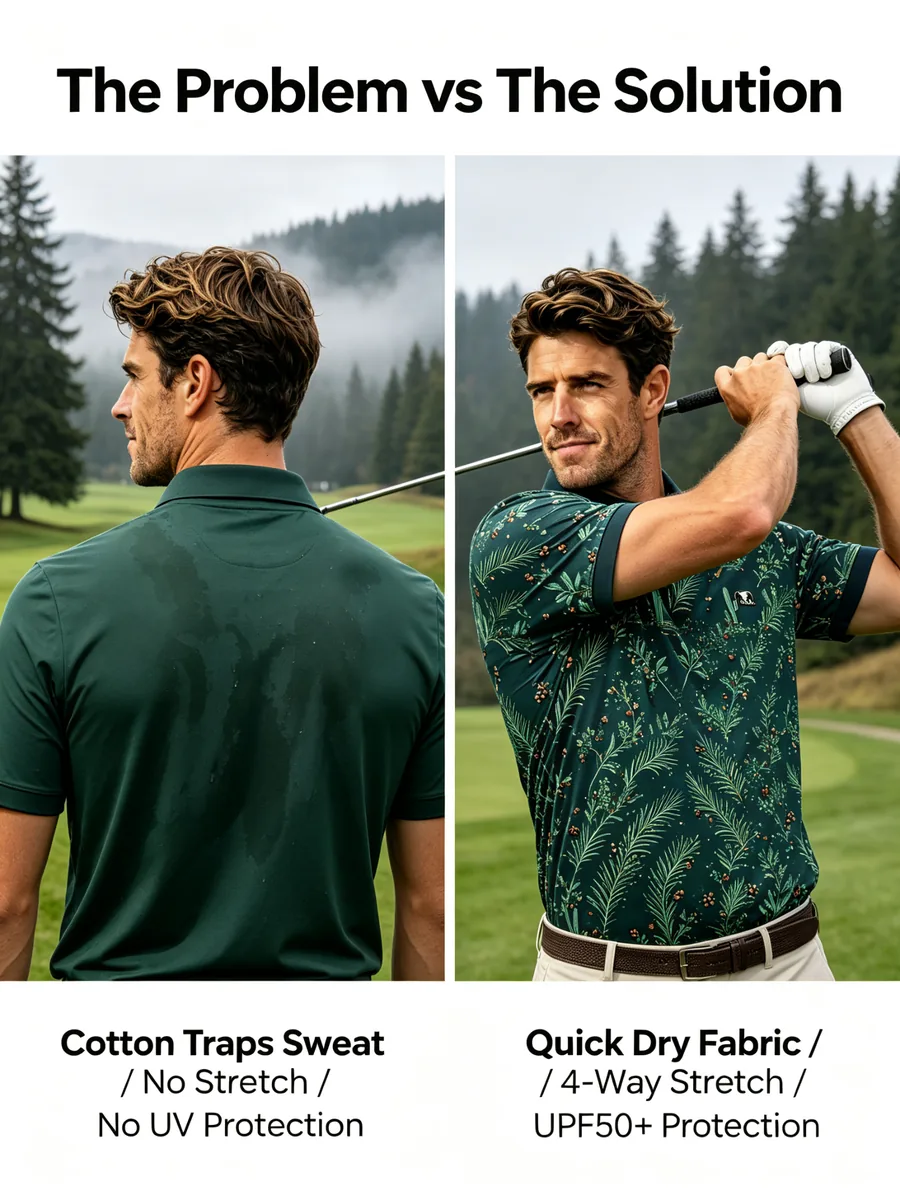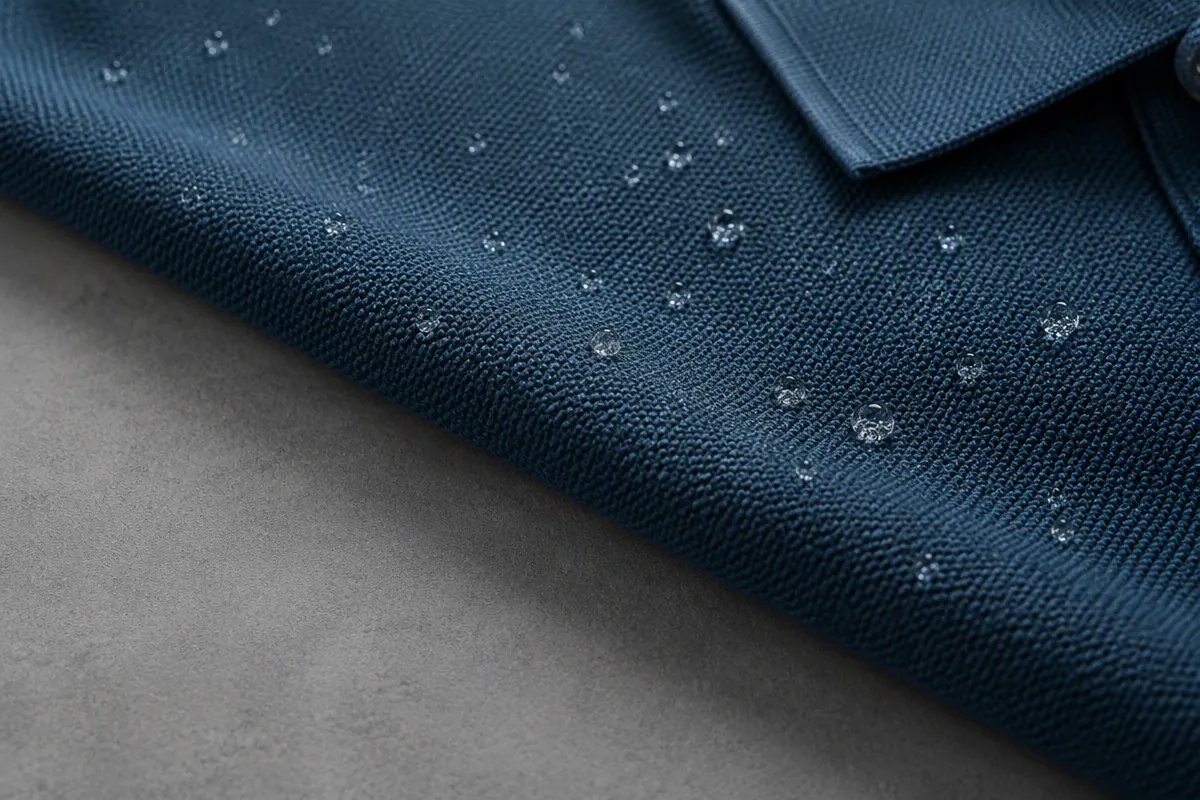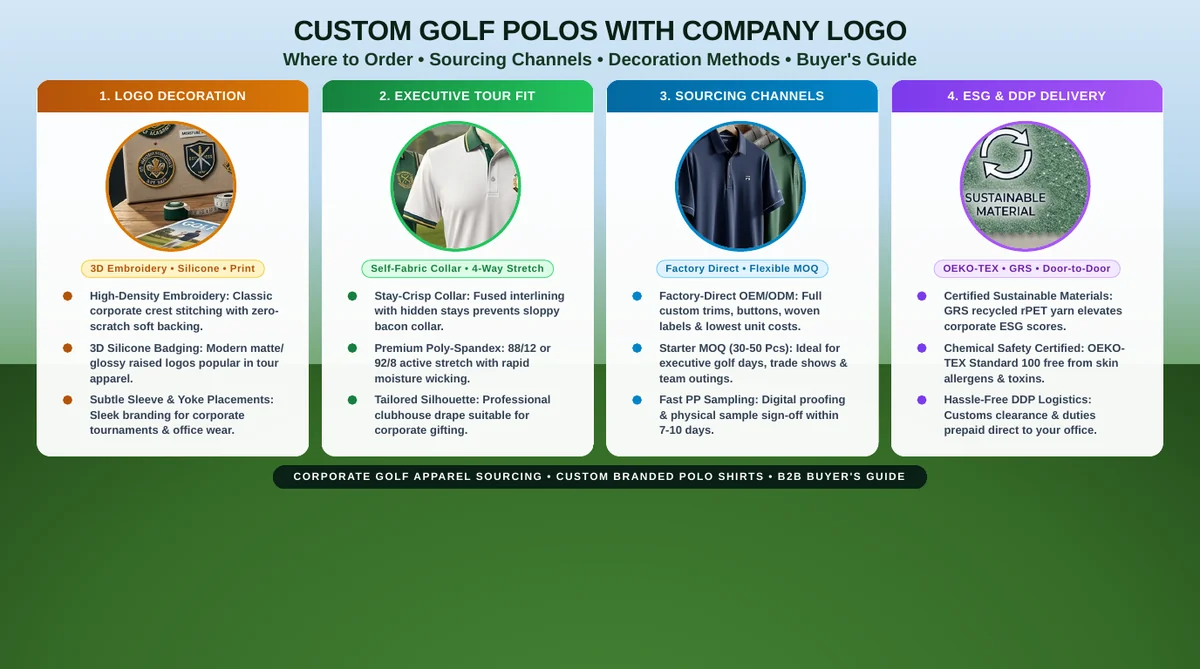
Short answer: the men's golf shirts that survive a season of weekly wear are 165-185 GSM knits in roughly 88-92% polyester with 8-12% spandex, in piqué, interlock or mesh, with a collar that holds its shape and a decoration method chosen before the fabric. Our own men's range runs 165-185 GSM with 8-15% spandex, and lands between $8.90 and $16.50 per piece depending on quantity.
What "golf t-shirt" means when you are actually buying
Men search for "golf t shirt", but what gets worn on a course is almost always a collared polo or a quarter-zip. Club dress codes usually ask for a collar, so a crew-neck performance tee is often turned away at the first tee. That is not a technicality: the collar is the part of the garment that fails first on a cheap shirt, and it is the part buyers notice every time they put it on.
This guide therefore covers men's collared golf shirts, which is what the search term usually means when a club, a company or a brand is ordering. If you genuinely need a crew-neck performance tee for practice or the driving range, say so in the brief: it is a different garment, it is costed differently, and it should not be compared with a polo on price alone.
Six things that decide whether a shirt works
| Criterion | What to ask for | Why it decides the outcome |
|---|---|---|
| Fibre and spandex content | 88-92% polyester, 8-12% spandex; up to 15% for an athletic cut | Spandex is what lets the knit recover after a swing instead of staying stretched across the chest. |
| Fabric weight | 165-185 GSM, stated in writing | A 15 GSM difference is visible in the hand and in how the shirt hangs. Suppliers who cannot give a figure are guessing. |
| Knit construction | Piqué for structure, interlock for a smooth face, mesh for airflow, jersey for drape | Two shirts at the same weight can behave completely differently depending on the knit. |
| Collar build | Bonded or fused collar stand with a shaped interlining | The collar is the first thing to curl. A soft self-fabric collar with no interlining will not stay flat after washing. |
| Decoration method | Decide embroidery, print or sublimation before the fabric is chosen | High-density embroidery needs a knit that can carry the stitch count; sublimation needs a polyester surface to dye. |
| Size grading | The actual size run and a measurement chart, not just "S-3XL" | An eight-size run from XS to 4XL covers more of a club membership than a seven-size run starting at S. |
Top picks for men
These are six styles from our current men's range, chosen because each answers a different brief rather than because one is "best". Prices are indicative per piece and move with quantity.
| Pick | Style | Fabric and weight | Sizes | Indicative price | Best for |
|---|---|---|---|---|---|
| Best overall | Performance Golf Polo | 88% micro-polyester / 12% spandex interlock, 175 GSM | XS-4XL (8) | $13.50 at 50 pcs, $8.90 at 1,000 | Weekly club and corporate wear |
| Best for embroidery | Corporate Embroidered Polo | 90% polyester / 10% spandex piqué mesh, 185 GSM | S-4XL (7) | $14.80 at 30 pcs, $9.20 at 1,000 | Crests, sponsor logos, staff uniforms |
| Best for full-colour artwork | Sublimated Golf Polo | 92% polyester / 8% spandex knit, 170 GSM | XS-4XL (8) | $14.50 at 50 pcs, $9.60 at 1,000 | All-over prints and photographic designs |
| Best in heat | Pastel Melon Technical Mesh Polo | 90% polyester / 10% spandex technical mesh, 165 GSM | XS-4XL (8) | $15.00 at 50 pcs, $9.80 at 1,000 | Hot, humid climates and early-morning rounds |
| Best recycled option | Recycled rPET Golf Polo | 88% GRS-certified recycled polyester / 12% spandex, 170 GSM | XS-3XL (7) | $15.00 at 50 pcs, $9.80 at 1,000 | ESG briefs and tender requirements |
| Best athletic cut | Blade Collar Golf Shirt | 85% microfiber polyester / 15% spandex, 165 GSM | S-3XL (6) | $14.20 at 50 pcs, $9.40 at 1,000 | A tapered, modern fit |
How to read a spec sheet without a lab
Fabric weight is the single most useful number on a golf shirt specification, because it predicts how the garment will feel and how it will drape before you ever touch it.
| Weight | What it feels like | Where it suits |
|---|---|---|
| 165 GSM | Light and airy, moves with the body, least structure in the collar | Hot climates, summer tournaments, mesh constructions |
| 170-175 GSM | The middle ground most buyers settle on: enough body to look smart, still cool | All-season club wear and corporate uniforms |
| 180-185 GSM | Denser hand, holds a crease and a collar shape well | Embroidery-heavy programs and cooler markets |
Ask for four figures on any quote: fibre percentages, spandex percentage, GSM, and shrinkage after three washes. If a supplier can only answer the first, the other three will be discovered by your customers instead of by you.
Buying tips for clubs, brands and corporate buyers
- Sample first, then wash it three times. Collar curl, print cracking and shrinkage all appear after washing, not on the hanger.
- Fix the decoration before the fabric. A three-colour crest and a full-colour photograph need different base cloths and different lead times.
- Order the size run you will actually sell. An eight-size run from XS to 4XL serves a mixed membership better than a seven-size run starting at S.
- Budget by colourway, not by order. Minimum order quantity applies per colour, so four colours at 50 pieces is 200 pieces in total.
- Ask for the certificate scope, not the logo. Any supplier can put a mark on a page; ask which product class a certificate covers and request a copy of the document.
- Plan for the second order. Sampling and decoration setup are paid once. A repeat order in the same style and artwork is materially cheaper.
Common mistakes
- Buying on colour and price, ignoring weight. Two shirts that look identical in a photo can be 165 and 185 GSM.
- Assuming a soft collar is a comfortable collar. Soft collars are comfortable for one round and shapeless by the fifth wash.
- Choosing print for a two-colour logo. Below roughly three colours, embroidery is usually the cheaper and more durable route.
- Trusting the size label. Chest measurements vary by supplier; ask for the chart and measure one shirt before the bulk run.
- Forgetting that MOQ applies per colourway. This is the most common reason a first order costs more than the buyer expected.
FAQ
Q1. What is the best fabric for a men's golf t-shirt?
A knit of roughly 88-92% polyester with 8-12% spandex, at 165-180 GSM, in piqué, interlock or mesh. Polyester moves moisture to the surface and dries quickly; spandex gives the recovery that keeps the shirt in shape through a round.
Q2. Is a polo better than a crew-neck tee for golf?
For the course, usually yes, because club dress codes generally specify a collar. For practice, the range or the gym, a crew-neck technical tee is fine. Check your own club's rules rather than assuming.
Q3. Which fabric weight should I choose?
165-170 GSM for hot climates and mesh styles, 175 GSM as an all-season default, 180-185 GSM when the design carries heavy embroidery or the market is cooler.
Q4. How much does a custom men's golf shirt cost?
In our current range, $8.90 to $16.50 per piece depending on style and quantity, with the 1,000-piece tier between $8.90 and $10.80. Treat these as indicative: decoration, colour count and delivery terms move the final figure.
Q5. What is the minimum order?
50 pieces per colourway across our range. The minimum applies per colour, so a four-colour order starts at 200 pieces.
Q6. How long does production take?
Samples are typically 5-7 days. Bulk production runs 7-15 days after sample approval, and DDP delivery to Europe is commonly 28-35 days in total.
Sources
- Mega Elephant men's polo specification records, 2026-10 (fibre content, GSM, size run, price ladder, decoration methods)
- Mega Elephant standard production terms, 2026-10 (MOQ, sample and bulk lead times, DDP delivery)
- Figures in this article are manufacturing specifications and catalogue prices, not third-party laboratory test results