Quick technical definition: A company logo golf polo order is a custom run of 50 to 100 pcs per colourway with your brand mark applied by embroidery, 3D silicone, heat transfer or sublimation, produced in 165 to 180 GSM performance fabric and delivered in 16 to 22 days to the US West Coast or 28 to 35 days to the EU. The four decoration methods differ mainly in stitch or film durability and in how fine your logo detail can be.
1. The short answer
You can order direct from an export-oriented golf apparel factory, or through a local print broker. Ordering direct gives you control over the fabric spec and the logo method, and usually removes one layer of markup. Whichever route you pick, confirm these five things first:
- MOQ of 50 to 100 pcs per colourway, with sizes spread across your team.
- A decoration method matched to your logo detail and wash expectations.
- Vector artwork with Pantone references supplied before sampling.
- A physical sample in 3 to 5 days, with the first revision free.
- Delivery in 16 to 22 days to the US West Coast or 28 to 35 days to the EU under DDP.
If a supplier will not commit to a physical sample before the run, the colour and placement risk sits with you.
2. What to check before you order
| Check | What to ask for | Why it matters for a logo order |
|---|---|---|
| Minimum run | 50 to 100 pcs per colourway | Department orders rarely reach 500 pcs |
| Artwork format | Vector file with Pantone codes | Bitmaps distort fine logo detail |
| Digital mockup | 24 hours after artwork approval | Confirms placement before sampling |
| Physical sample | 3 to 5 days, first revision free | Shows real stitch and colour |
| Embroidery durability | 50+ washes without thread breakage | Keeps the mark crisp after laundering |
| 3D silicone durability | 60+ washes | Raised badge holds its edge |
| Fabric weight | 165 to 180 GSM | Stable base for dense stitching |
| Shrinkage | Under 1.5% after 5 washes | Prevents the logo distorting |
| Collar durability | Stays flat 50+ industrial washes | Collar is the most visible panel |
| Size tolerance | +/- 0.5 in / 1.5 cm | Logo sits consistently across sizes |
| Sizing blocks | US Standard Fit and European Slim Fit | Covers mixed regional teams |
| Compliance | OEKO-TEX Standard 100, REACH, BSCI | Needed for staff uniform programmes |
3. Which logo method fits your mark
The right method depends on your logo detail, the look you want and how often the shirts get washed:
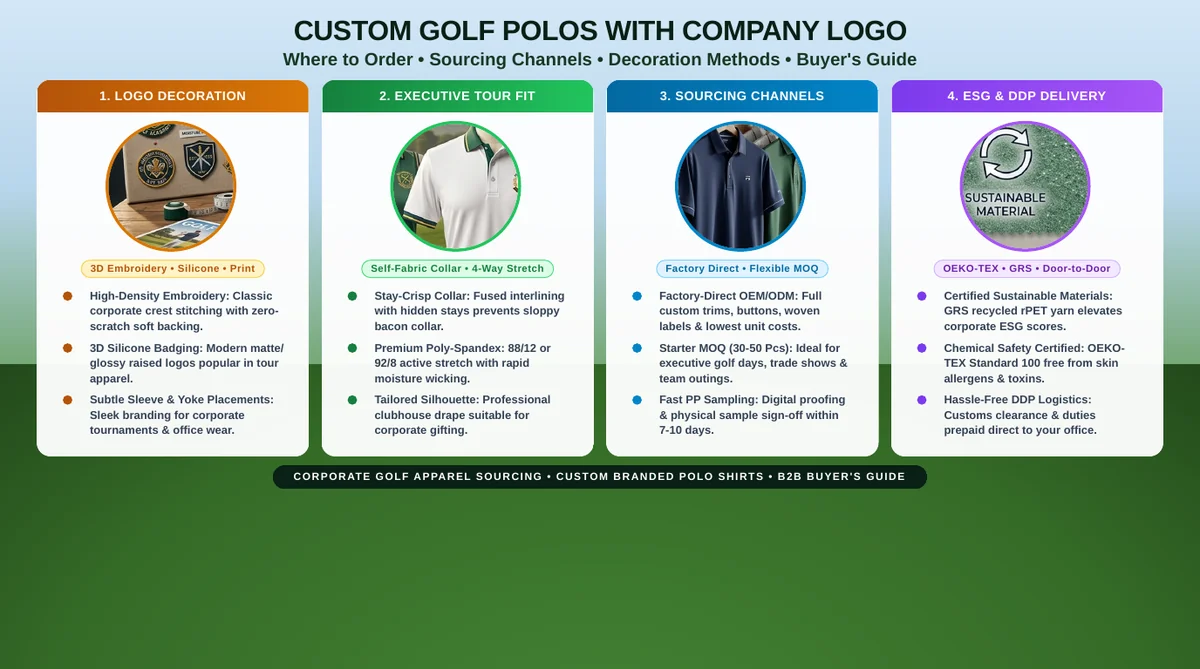
- High-density embroidery. Best for simple one or two colour marks with clean edges. It gives a classic raised thread look and holds 50+ washes. Very fine text below about 4 mm can fill in, so simplify the mark if needed.
- 3D silicone. Best for a raised, rubber-feel badge with crisp edges. It holds 60+ washes and reads well on the left chest. It suits marks with a solid shape rather than fine gradients.
- Heat transfer. Best for photographic or gradient artwork that stitching cannot reproduce. It sits flat and light, and works when the design has many colours.
- Full-coverage sublimation. Best for all-over prints where the logo is part of the panel design rather than a badge. The colour sits in the fibre, so it does not crack or peel.
If you are unsure, send the same artwork for two methods in one sample round. The cost difference at sample stage is small compared with a full run in the wrong method.
4. How to place the order
Work through these five steps:
- Export the logo as vector artwork with Pantone references. AI, EPS or SVG formats reproduce cleanly; a PNG from your website usually does not.
- Choose the garment and fit. Pick US Standard Fit or European Slim Fit, and confirm size tolerance of +/- 0.5 in / 1.5 cm.
- Pick the decoration method and placement. Left chest, sleeve or back yoke, and note the maximum badge width.
- Approve a physical sample. Check thread tension, edge definition, colour match in daylight and how the panel sits after one wash.
- Confirm the tech pack in writing. Lock fabric code, stitch type, Pantone references, placement coordinates and packing rules before production starts.
A complete brief usually removes one to two weeks of back-and-forth.
5. Buying implications
To get an accurate quote, include:
- Vector logo file and Pantone codes.
- Garment style, colourway and size split.
- Decoration method and placement.
- Quantity, and the price at 50, 100 and 300 pcs for comparison.
- Delivery terms: DDP to a named port or door-to-door.
- Compliance needs: OEKO-TEX Standard 100, and REACH alignment for EU staff programmes.
Ask for the price at 50, 100 and 300 pcs in one quote. The per-unit drop between 50 and 100 is usually steeper than between 100 and 300, so a slightly larger order often costs less per shirt.
FAQ
Q1. What is the minimum order for logo golf polos?
50 to 100 pcs per colourway. A team of 40 to 60 people can reach that with one shirt each plus spares for new starters.
Q2. How long does a company logo order take?
16 to 22 days to the US West Coast or 28 to 35 days to the EU from PO confirmation, plus 3 to 5 days for sampling. A 72-hour rapid sample is available when the event is close.
Q3. Which logo method should we choose?
High-density embroidery for a classic one or two colour mark, 3D silicone for a raised badge, heat transfer for gradients or photos, and sublimation for all-over prints.
Q4. Can you match our brand Pantone exactly?
Usually within one shade step on polyester. Thread and silicone are mixed to order, but the base fabric colour affects the final read, so approve a physical sample under daylight before the run.
Q5. Do we have to supply vector artwork?
Yes for embroidery and 3D silicone, because both need clean edges to digitise. A bitmap can work for heat transfer or sublimation, but resolution limits how large the mark can print.
Q6. Can we reorder the same spec next year?
Yes, if the tech pack was confirmed in writing. Keep the fabric code, Pantone references and placement coordinates; without them a repeat run can shade or shift slightly.
Related reading
- custom golf polos with logo
- sublimation vs embroidery vs heat transfer for golf polo logos
- custom golf shirts for corporate events and tournaments
- contact us for a logo polo quote
Sources
- Mega Elephant factory parameter sheet: MOQ 50-100 pcs, US lead time 16-22 days, EU lead time 28-35 days DDP, 165-180 GSM, shrinkage under 1.5%.
- Embroidery durability 50+ washes and 3D silicone 60+ washes, per internal wash testing.
- OEKO-TEX Standard 100, REACH, BSCI and Sedex SMETA compliance frameworks.