Quick technical definition: A BSCI audit is a third-party social-compliance assessment that scores a factory from A to E across 13 performance areas. For European golf apparel buyers, it is the most commonly requested audit at onboarding.
Our factory rating: B. Lead time to EU: 28-35 days. Certifications held: OEKO-TEX Standard 100, GRS, BSCI, WRAP, Sedex SMETA, REACH (EU).
Relevant when sourcing for golf brands, country clubs, distributors and corporate buyers in the EU; less relevant for buyers who only sell into markets without social-compliance requirements. Request a sample kit before committing to a run.
Updated: 2026-09-11 · Technical review for Compliance
Contents
1. What BSCI covers
The Business Social Compliance Initiative (BSCI) monitors social performance in global supply chains. It checks 13 areas: fair compensation, working hours, occupational health and safety, child labor, forced labor, freedom of association, discrimination, disciplinary practices, social management systems, environmental protection, and supply chain transparency.
For golf apparel factories, the most frequently failed areas are working-hour records and wage documentation. A factory with a B rating has documented systems and evidence that pass unannounced follow-up checks.
2. Audit ratings and validity
| Rating | Meaning | Validity |
|---|---|---|
| A | Outstanding compliance | 2 years |
| B | Good compliance with minor findings | 2 years |
| C | Acceptable, but improvements required | 1 year |
| D | Major non-compliances | Re-audit required |
| E | Unacceptable | Immediate remediation |
A B rating is sufficient for most EU retailers and distributors. Some large German and Scandinavian chains require A or B with zero open findings. Always ask for the full report, not just the summary letter.
3. Why European buyers require it
EU market access increasingly depends on documented supply-chain due diligence. The German Supply Chain Due Diligence Act, the French Duty of Vigilance Law, and the upcoming EU Corporate Sustainability Due Diligence Directive all expect buyers to verify social compliance at tier-1 factories.
A valid BSCI report reduces audit duplication. It also shortens vendor onboarding because the same report is accepted by multiple EU retailers. Without it, buyers face delayed listings, additional audit costs, and supply-chain disruption risk.
4. Certifications and standards
| Certification / standard | What it covers | Why it matters |
|---|---|---|
| BSCI | Social compliance, 13 performance areas | Required by most EU retailers |
| OEKO-TEX Standard 100 | Harmful substance testing | Skin-safe garments for end consumers |
| GRS (Global Recycled Standard) | Recycled content chain of custody | Sustainability claims for rPET fabrics |
| WRAP | Legal, ethical, safe manufacturing | US and EU brand assurance |
| Sedex SMETA | Labor and health & safety audit | Shared audit platform reduces duplication |
| REACH (EU) | Chemical registration and restriction | Legal sale in EU member states |
| PFAS-free | No fluorinated chemistry | Aligns with EU chemical strategy |
5. How to verify the report
Do not accept a screenshot. Ask for the BSCI report reference number and check it directly with the audit body. Confirm the audit scope covers the exact factory name and address that will produce your order, not a sister facility.
Also check the corrective action plan. A B rating with open findings is common; what matters is whether the factory closed those findings on time and has evidence.
6. RFQ checklist
Use these questions as your RFQ checklist. A factory that answers all of them in numbers is rare and worth testing:
- What is the MOQ per colorway, and what changes at 50 vs 300 vs 1000 pcs?
- Which certifications are current and verifiable (OEKO-TEX, GRS, BSCI, WRAP, Sedex, REACH)?
- What are the lead times DDP to EU and to US West Coast, contractually?
- What are the shrinkage and colorfastness limits, with test methods?
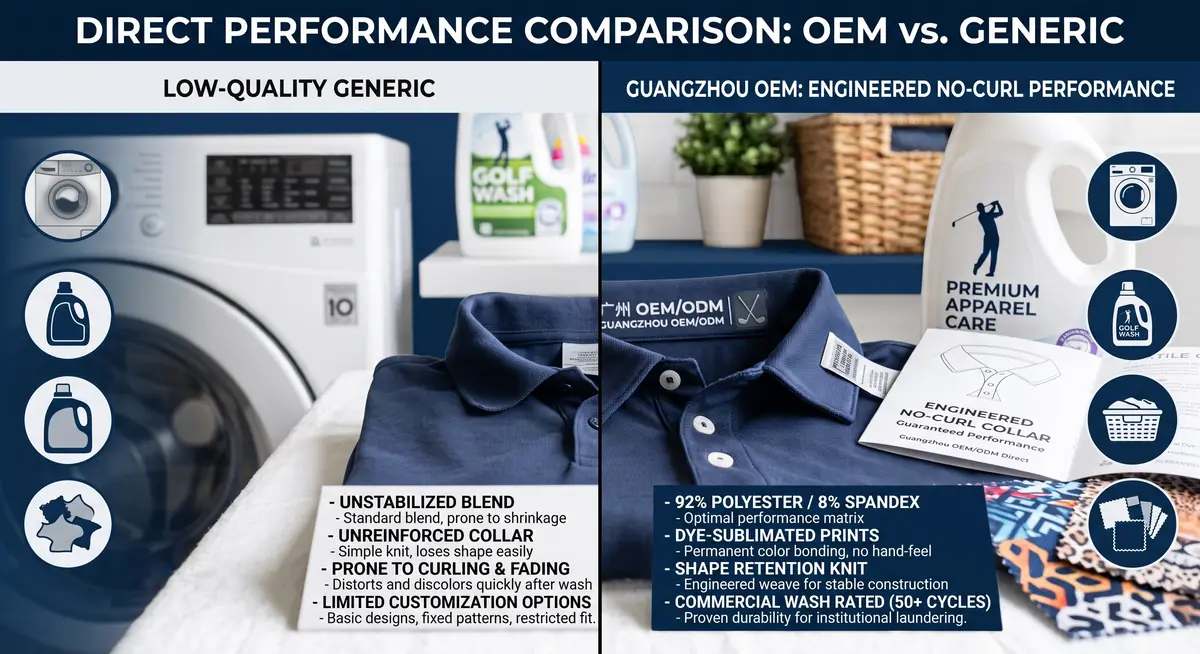
- What happens to collar shape after 50 industrial washes?
- Ask for a physical sample before PO. Never skip it.
FAQ
Q1. What is the BSCI rating of your golf apparel factory?
B. Good compliance with minor findings, valid for 2 years. Confirm the same figure in writing on the tech pack before production.
Q2. Is a sample mandatory before ordering?
Yes. Fabric hand feel and decoration placement cannot be judged from photos. Order a physical counter sample first; most factories ship one in 3-5 days.
Q3. Does a lower MOQ mean a much higher unit price?
Not always. A factory built for small runs can hold price within a narrow band because its setup cost is low. Ask for the price at 50, 300 and 1000 pcs in one quote.
Q4. How long does production take from PO to delivery?
28-35 days to EU ports under DDP Incoterms, sea to Hamburg / Rotterdam / Felixstowe, from PO confirmation. Express options to the US West Coast are shorter; confirm both at quote time.
Q5. What should I check before signing with a golf apparel factory?
Certification numbers you can verify online, a physical sample, one reference client, and the on-time delivery clause. A factory that hesitates on any of these four is a risk.
Q6. Will collar curling come back after a few washes?
With a stay-flat interlining construction it holds through stays flat 50+ industrial washes. Curling returns when the interlining is thin or the knit density low. That is a spec issue, not a laundry issue.
Related reading
- custom golf polos with logo
- complete guide to golf apparel compliance certifications
- resources
- contact
Sources
- BSCI (amfori)
- OEKO-TEX Standard 100
- GRS (Global Recycled Standard)
- WRAP
- Sedex SMETA
- REACH (EU)