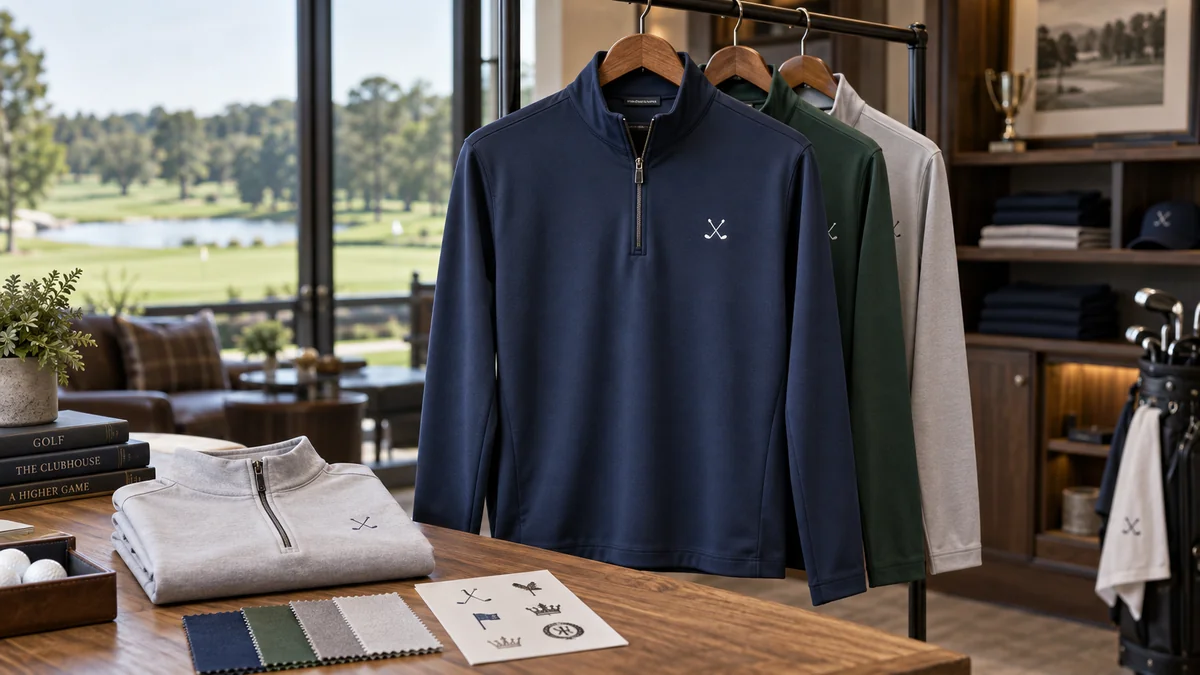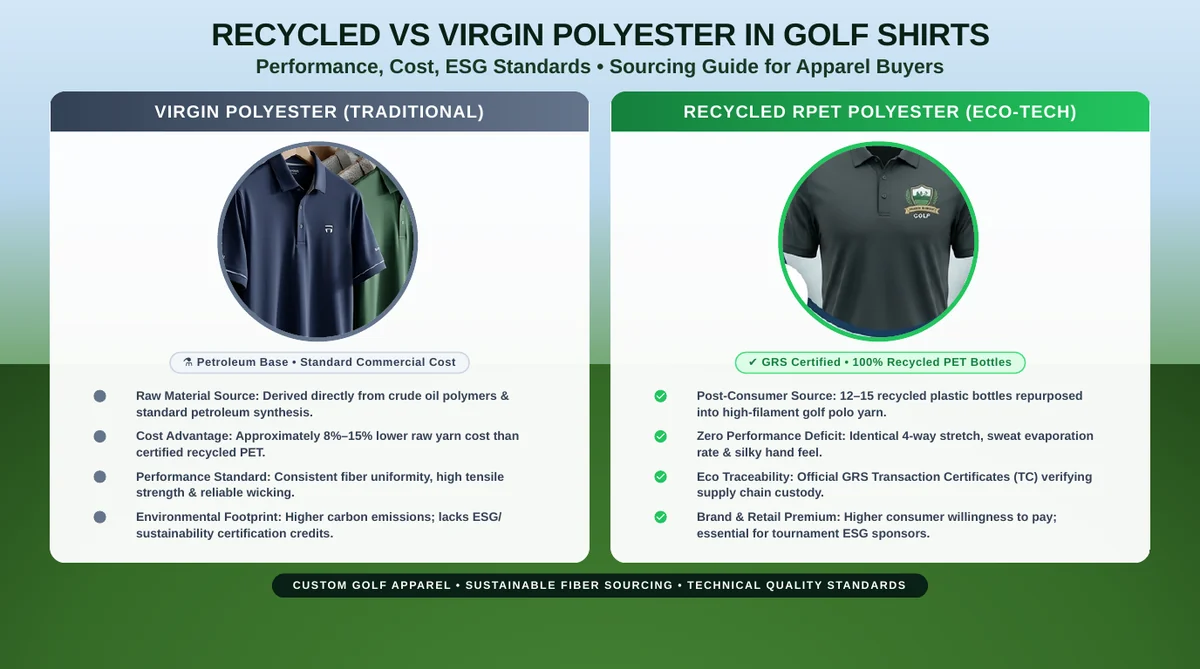
Quick technical definition: Virgin polyester is petroleum-based PET; RPET recycled polyester is post-consumer bottle flake re-spun into 165-180 GSM filament yarn. The side-by-side choice matters for custom golf apparel when order volume, ESG claims and wash expectations are on the table.
MOQ: 50-100 pcs per colorway. Lead time to EU: 28-35 days. Collar durability: stays flat 50+ industrial washes.
Relevant when sourcing for golf brands, country clubs, distributors and corporate buyers in the US and EU; less relevant for pure off-the-shelf retail stock. Request a sample kit before committing to a run.
Updated: 2026-09-02 · Technical review for Fabric
Contents
1. The short answer
If your program values the lowest raw material cost and the widest color range, choose virgin polyester. If the buyer, brand or tournament requires an ESG story, GRS certification or a recycled-bottle claim, choose RPET recycled polyester. On our 165-180 GSM performance line the stretch, UPF 50+ and collar durability difference is effectively zero because both yarn types are finished on the same machines. The real decision line is price tolerance: RPET raw yarn runs about 8-15% higher than virgin, which maps to roughly 5-10% at the finished garment level for 300 to 1000 piece orders.
2. Side-by-side: Virgin Polyester vs RPET Recycled Polyester
| Dimension | Virgin polyester | RPET recycled polyester |
|---|---|---|
| Raw material source | Crude oil polymers and standard PET synthesis | 12-15 post-consumer plastic bottles per garment |
| MOQ | 50-100 pcs per colorway | 50-100 pcs per colorway |
| Lead time to EU | 28-35 days | 28-35 days |
| Fabric weight | 165-180 GSM | 165-180 GSM |
| UV protection | UPF 50+ | UPF 50+ |
| Shrinkage | under 1.5% after 5 washes | under 1.5% after 5 washes |
| Collar durability | stays flat 50+ industrial washes | stays flat 50+ industrial washes |
| 3D silicone logo durability | 60+ washes | 60+ washes |
| Raw yarn cost | roughly 8-15% lower than RPET | about 8-15% higher than virgin |
| Certifications | OEKO-TEX Standard 100, REACH | OEKO-TEX Standard 100, GRS, REACH |
| ESG / sustainability credits | Not eligible | Eligible for GRS, recycled-content claims |
Both fabrics are knitted, dyed and finished on the same machines in our Guangzhou facility. The shared parameters (MOQ, lead time, GSM, UPF, shrinkage, collar durability and logo durability) come from the same process line. The differences are raw material source, certification burden and consumer perception. Virgin polyester dyes cleanly and is the default for cost-sensitive or color-critical orders. RPET is required when a buyer or retailer asks for verifiable recycled content.
3. Virgin polyester in detail
Virgin polyester is made from petroleum-derived PET chips that are polymerized and melt-spun into filament yarn. The fiber is consistent, uniform and takes dye predictably, which is why it remains the standard for bright colors, complex logos and cost-sensitive runs. Our virgin polyester polos are knitted to 165-180 GSM and finished with pre-shrunk treatment, so shrinkage stays under 1.5% after 5 washes and UPF 50+ passes AATCC 183. The cost advantage is on the raw material side: virgin PET chip is roughly 8-15% cheaper than certified RPET chip. That saving is most visible on large runs where raw material dominates the unit cost. Choose virgin polyester when the design uses neon or pastel shades where dye consistency matters most, when the buyer has no ESG requirement, or when the target retail price is under $35.
4. RPET recycled polyester in detail
RPET recycled polyester starts as post-consumer plastic bottles that are cleaned, shredded into flakes, melted and re-spun into filament yarn. The physical shirt is often indistinguishable from virgin polyester because both run through the same knitting and finishing line. To claim recycled content and use the RPET label, the factory must hold GRS (Global Recycled Standard) and provide Transaction Certificates for the yarn lot. Our RPET line uses 12-15 bottles per garment, carries OEKO-TEX Standard 100 and REACH compliance, and delivers the same 165-180 GSM, UPF 50+ and under 1.5% shrinkage after 5 washes. The premium is documentation-driven, not performance-driven. Choose RPET when the purchase order specifies recycled content, when the end retailer requires GRS paperwork, or when the brand markets the garment as made from recycled bottles. It is unnecessary for internal corporate uniforms that do not carry an environmental claim.
5. Cost and longevity
At the raw yarn level, RPET is typically 8-15% more expensive than virgin polyester because of collection, cleaning and certification costs. At the finished garment level for a 300 to 1000 piece order, the gap narrows to roughly 5-10% because cutting, sewing, decoration and shipping costs are identical. Both fabrics reach the same longevity in our internal test protocol: collar stays flat through 50+ industrial washes and 3D silicone logos hold through 60+ washes. Shrinkage stays under 1.5% after 5 washes for both. The cost difference is therefore a marketing and compliance decision, not a durability trade-off. For orders under 100 pieces, the RPET premium feels larger because the fixed sampling and setup costs are spread over fewer units.
6. How to select
- Use virgin polyester when cost and color range come first. It is roughly 8-15% cheaper on raw yarn and is the better choice for designs with neon or pastel shades where dye consistency matters most.
- Use RPET recycled polyester when ESG credentials are required. GRS certification and Transaction Certificates are necessary for recycled-content claims, tournament ESG sponsorships and EU retailer onboarding.
- Match either option to the same production minimum. Both run at MOQ 50-100 pcs per colorway with 28-35 days to EU ports and 16-22 days to the US West Coast.
- Order a physical sample before committing. Fabric hand feel and decoration placement cannot be judged from photos. Most counter samples ship in 3-5 days.
7. RFQ checklist
Use these questions as your RFQ checklist. A factory that answers all of them in numbers is rare and worth testing:
- What is the MOQ per colorway, and what changes at 50 vs 300 vs 1000 pcs?
- Which certifications are current and verifiable (OEKO-TEX, GRS, BSCI, WRAP, Sedex, REACH)?
- What are the lead times DDP to EU and to US West Coast, contractually?
- What are the shrinkage and colorfastness limits, with test methods?
- What happens to collar shape after 50 industrial washes?
- Ask for a physical sample before PO. Never skip it.
FAQ
Q1. What is the moq for RPET recycled polyester golf shirts?
50-100 pcs per colorway. minimum order for custom production. The same minimum applies to virgin polyester golf shirts. Confirm the same figure in writing on the tech pack before production.
Q2. Is a sample mandatory before ordering Recycled Polyester 88% / Spandex 12%?
Yes. Fabric hand feel and decoration placement cannot be judged from photos. Order a physical counter sample first; most factories ship one in 3-5 days.
Q3. Does a lower MOQ mean a much higher unit price?
Not always. A factory built for small runs can hold price within a narrow band because its setup cost is low. Ask for the price at 50, 300 and 1000 pcs in one quote.
Q4. How long does production take from PO to delivery?
28-35 days to EU ports under DDP Incoterms, sea to Hamburg / Rotterdam / Felixstowe, from PO confirmation. Express options to the US West Coast are shorter; confirm both at quote time.
Q5. What should I check before signing with a golf apparel factory?
Certification numbers you can verify online, a physical sample, one reference client, and the on-time delivery clause. A factory that hesitates on any of these four is a risk.
Q6. Will collar curling come back after a few washes?
With a stay-flat interlining construction it holds through stays flat 50+ industrial washes. Curling returns when the interlining is thin or the knit density low. That is a spec issue, not a laundry issue.
Related reading
Sources
- OEKO-TEX Standard 100
- GRS (Global Recycled Standard)
- BSCI
- WRAP
- Sedex SMETA
- REACH (EU)