Quick technical definition: On a custom golf shirt in 165 to 180 GSM performance knit, embroidery stitches your logo into the fabric and holds 50+ washes with a raised, corporate look, while printing (heat transfer or sublimation) lays colour on or into the fibre and handles gradients and photo detail that thread cannot. The choice comes down to logo detail, wash expectations and the look your brand needs.
1. The short answer
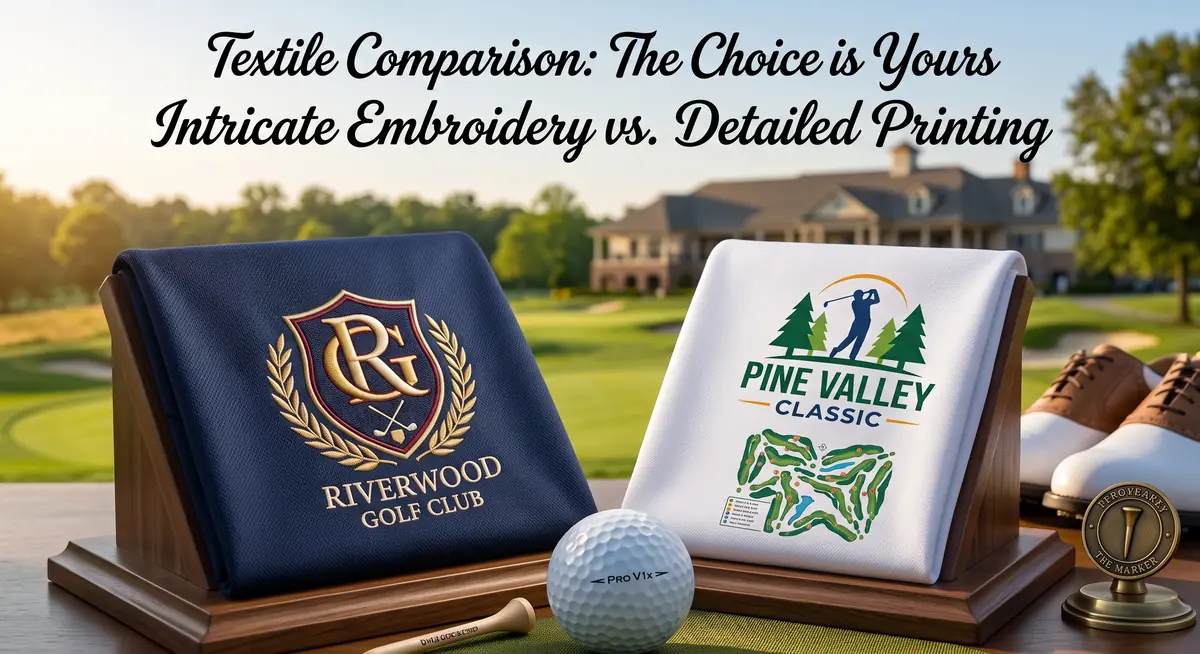
Choose embroidery when your logo is a simple one or two colour mark with clean edges and you want the classic raised chest badge most clubs and corporates expect. Choose printing when your artwork has gradients, photographic elements or many colours that stitching would fill in or oversimplify. A practical rule from production: if the logo reads clearly at 4 cm wide in pure thread colours, embroider it; if it loses detail, print it.
Neither method is "better" in general. The wrong pairing shows up in one of two ways: a complex logo embroidered into an unreadable blob, or a simple corporate mark printed flat and looking cheap after 20 washes.
2. Decision table: 5 checks that settle it
| Check | Choose embroidery when | Choose printing when |
|---|---|---|
| Logo detail | 1 to 3 solid colours, clean edges, text above 4 mm | Gradients, photos, more than 4 colours, fine texture |
| Look you want | Raised, textured, corporate badge | Flat, lightweight, photorealistic panel |
| Wash durability | 50+ washes without thread breakage | Heat transfer: 30+ washes; sublimation: permanent in the fibre |
| Fabric base | 165 to 180 GSM knit with backing | Heat transfer on knit; sublimation on light or white polyester |
| Typical placement | Left chest, sleeve, back yoke | Full front, all-over panels, back yoke |
One hybrid worth knowing: a simplified embroidered chest badge plus a heat-transfer sleeve badge carries fine detail without compromising the main mark.
3. How each method is specified
Embroidery. Your vector artwork is digitised into a punch file that drives stitch direction and density. Specify thread Pantones, backing type and the badge size. Limits: text below about 4 mm fills in, and very dense stitching can pucker lightweight knit, so the digitiser balances density against fabric weight. Done right, the badge holds 50+ washes.
Heat transfer. Your artwork is printed on film and pressed onto the garment. It reproduces gradients and photos at full fidelity and sits flat and light. Specify the artwork at print resolution and confirm the press temperature suits the fabric. Expect around 30+ washes before visible wear, which is fine for event shirts and seasonal programmes.
Sublimation. Colour is bonded into the polyester fibre itself, so it cannot crack or peel, and it is the only option for all-over prints. It needs a light or white polyester base, because it does not lay colour on top of dark fabric.
For a deeper method-by-method comparison, see the sublimation vs embroidery vs heat transfer guide.
4. What it means for cost and timing
- Setup. Embroidery carries a one-time digitising cost per logo size; printing carries per-colour or per-film setup. At 50 to 100 pcs per colourway, both setup costs amortise similarly, so the artwork should decide the method, not the setup fee.
- Per-unit cost. Embroidery cost scales with stitch count, so a large back badge costs more than a small chest mark. Printing cost scales with coverage area and colour count.
- Timing. Both run inside the standard 16 to 22 days to the US West Coast or 28 to 35 days to the EU. Sampling is 3 to 5 days with a 72-hour expedited option; a stitched or pressed sample is the only reliable way to judge the look.
- Reorders. Keep the punch file (embroidery) or the print file (transfer) in the tech pack so a repeat run matches the first.
The most expensive outcome is a full run in the wrong method. If you are between the two, send the same artwork for both in one sample round: the sample cost is small, and the physical comparison ends the debate in one day.
5. Buying implications
To get a comparable quote on both methods in one round:
- Supply vector artwork (AI, EPS or SVG) plus Pantone references.
- State the badge size and placement: left chest, sleeve or back yoke.
- Confirm fabric and weight: 165 to 180 GSM performance knit is the standard base.
- Ask for pricing at 50, 100 and 300 pcs per colourway, per method.
- Confirm durability targets in writing: 50+ washes for embroidery, 30+ for heat transfer.
- Check compliance if the shirts enter a uniform programme: OEKO-TEX Standard 100 and REACH alignment.
FAQ
Q1. Which method lasts longer on a golf shirt?
Embroidery holds 50+ washes; sublimation is permanent in the fibre; heat transfer lasts around 30+ washes before visible wear. For a corporate shirt washed weekly, embroidery or sublimation is the safe pick.
Q2. Can embroidery handle a gradient or photo logo?
No. Thread reproduces solid colour regions with clean edges. Gradients and photographic detail belong on heat transfer or sublimation.
Q3. Is embroidery more expensive than printing?
Per unit it depends on stitch count versus coverage. At 50 to 100 pcs per colourway the difference is usually small, so let the artwork detail decide rather than the setup fee.
Q4. What is the smallest text embroidery can reproduce cleanly?
About 4 mm cap height. Below that, fine strokes fill in. Move sub-4 mm detail to a printed badge or simplify the mark.
Q5. Does the fabric change the answer?
Yes. Heavy knit and bonded fleece carry embroidery very well; lightweight or dark polyester favours transfer; all-over photographic designs require sublimation on light polyester.
Q6. Can we combine both methods on one shirt?
Yes. A common build is an embroidered chest badge plus a heat-transfer sleeve or back-yoke badge for fine detail. Confirm both placements on the physical sample.
Related reading
- custom golf shirts embroidery
- custom sublimation all-over print golf polo
- sublimation vs embroidery vs heat transfer for golf polo logos
- why sublimated logos fade and how to prevent it
- contact us for a quote on both methods
Sources
- Mega Elephant factory parameter sheet: MOQ 50-100 pcs, US lead time 16-22 days, EU lead time 28-35 days DDP, 165-180 GSM performance knit, shrinkage under 1.5%.
- Embroidery durability 50+ washes, 3D silicone 60+ washes, heat transfer around 30+ washes, per internal wash testing.
- Sampling 3 to 5 days with 72-hour expedited option; quotes within 12 hours.
- OEKO-TEX Standard 100, REACH, BSCI and Sedex SMETA compliance frameworks.